Pages

Showing posts with label drama. Show all posts

Friday, March 24, 2017

Goethe's Erlkönig


A father is riding home. In his arms he holds a child. The child complains about strange beings trying to get him. The father is frightened and rides faster, but when he gets home, the child in his arms is dead.

It is oppressive as a poem. The strange figures in the dark try to seduce the child. It is not typical of Goethe’s work, though he did bow to nature and believed in extrasensory perception. And all his life he collected stories and theories from occult sciences. For instance, he seriously thought that Napoleon’s greatness was of deamonic origin.

Even so, this poem sounds like Goethe only in its language. It is too spooky in other regards, and there is no humour. Critics have always hesitated to acknowledge that in the child’s hallucinations there is an allusion to rape. The poem can be remembered quite clearly and even analyzed without that allusion.

Faust I   features short moments of similar cruelty, and these aren’t readily remembered or recalled either.


.
Below is the original text in German and my prose translation -- where, too late, I saw the accidental rhymes in the first lines.


I believe that versed translations do more harm than good. They certainly give the wrong idea of Shakespeare and Heine, just like the attempted translations of a writing style that distort or masque Cervantes, Huckleberry Finn, Marcel Proust.

There is great poetry without rhymes, and if there are rhymes, they are not elements of  decoration, but functional and necessary like the waves of the sea. In translation they become mere imitation showing the translator's skill or his tolerance.


Versed translation 1 http://www.recmusic.org/lieder/get_text.html?TextId=6382
Who's riding so late through night, so wild?
It is the father who's holding his child;

Versed translation 2 http://ingeb.org/Lieder/werreite.html
Why is your face so frightened my son?
The King of elves, father, see him yon?              o o o p s!

Versed translation 3 http://dererlkonig.wordpress.com/translations/
Who rides there so late through the night dark and drear?
The father it is, with his infant so dear;

Some poet, for instance Bob Dylan or Heinrich Heine, would not want the rhymes = waves of his verse to be so soft and smooth, and  he goes and disturbs them :) -- But that's another story.

Bob Dylan quoted from http://www.bobdylan.com/us/songs/i-shall-be-free-no-10:
I am a poet
And I know it.
.
.

Tuesday, September 13, 2016

Faust vs a little Silver Bell


Towards the end of the play, Faust is still employed by the bankrupt emperor. Inflationary policies are tearing up public peace, and a war breaks out.

Faust becomes a General and wins the war thanks to Mephistopheles' sorcery.


Now Faust is almighty and he plans to build a giant system of dams to push back the sea. He is successful, except for one spot, where he is held back by a chapl and a wood hut with two old people who do not want to move.


And great Faust suddenly shows signs of  impatience. He complains that he cannot stand the pealing of the chapel's little bell.

The silver bell of that chapel keeps reminding him that the whole world would be his ....if only  he also owned that one spot, and he and Mephistopheles concord that the pealing of that ominous bell must be stopped at once.


Mephistopheles allows the place to be torched by his rude subordinates.

.............................................................................

FAUST admits he feels ashamed that such a little bell could upset him. --
Wie schaff ich es mir vom Gemüte! --
Das Glöcklein läutet, und ich wüte.
How can I get rid of it! The little bell rings, and I rage.

MEPHISTOPHELES:

It's natural that such a basic inconvenience would spoil your complete life. Who would dispute that!
Natürlich daß ein Hauptverdruß
Das Leben dir vergällen muß.
Wer leugnet's!

Auch hier geschieht, was längst geschah,
Denn Naboths Weinberg war schon da.

It is Mephistopheles quoting from the Bible saying that Naboth was killed for his vineyard, and whatever happened then, will happen again.


..............................................


The photos are at http://en.prolinefilm.ru/gallery/?sect_id=1afb3426, taken from a film interpretation of "Faust" directed by Alexander Sokurov.

Goethe himself had used a source from the Middle Ages.

Basically it's the story of a science teacher who tries to get out of the racket by making a deal with the devil.
Goethe's Mephistopheles is a lucid well-read old cynic and more astute in his reflections than Faust himself.
Of Sokurov's film I have only seen the stills.
Below is Sokurov's "Gretchen", the girl seduced by Faust with Mephistopheles' decisive help.

....................................................................................


From Wikipedia https://en.wikipedia.org/wiki/Faust

Origins of the Faust story

"The Faust of early books—as well as the ballads, dramas, movies, and puppet-plays which grew out of them—is irrevocably damned because he prefers human to divine knowledge; "he laid the Holy Scriptures behind the door and under the bench, refused to be called doctor of Theology, but preferred to be styled doctor of Medicine".

Plays and comic puppet theatre loosely based on this legend were popular throughout Germany in the 16th century, often reducing Faust and Mephistopheles to figures of everyday fun."
.
.

Friday, April 22, 2016

Goethe Faust -- erster Teil


Der Professor verflucht seine Buecher und Papiere. Er doziert privat diverse Wissenschaften und waere das Getue allzu gerne los, kann es sich aber nicht leisten. Er sucht daher das Hintertuerchen im Okkultismus und bastelt sogar an einer Idee vom Tod als Moeglichkeit
 
Auf neuer Bahn den Äther zu durchdringen,
Zu neuen Sphären reiner Tätigkeit.
die Pforten aufzureißen,
Alexander Sokurov

 
Mit einem klassisch gereimten kühnen Trinkerspruch will er sein Kraemerdasein verlassen, doch ist es nun Ostermorgen und der Gesang der Engel haelt ihn ab.

English Version ... http://cantueso1.blogspot.com.es/2015/03/f-u-s-t-story.html


Das Arrangement mit Mephistopheles

Auf einem Spaziergang folgt ihm ein schwarzer Pudel und begleitet ihn mit allerlei Possen ins Studienkabinett. 

Faust:
Ist es Schatten?  ist's Wirklichkeit?
Wie wird mein Pudel lang und breit!
 
Welch ein Gespenst bracht ich ins Haus!
Schon sieht er wie ein Nilpferd aus,
 .
Aus dem Hund wird naemlich Mephistopheles, Goethes eigenster Ersatz fuer den christlichen Teufel.

Mephistopheles  ist ein aelterer Herr, philosophisch solvent, welterfahren und zudem elegant in Sprache und Kleidung. Dr Fausts wissenschaftlichen Bemuehungen gegenueber aeussert er sich schnippisch unverbindlich und wettet mit ihm um seine Seele:

Mephistopheles:  Ich gebe dir, was noch kein Mensch gesehn.

Faust:
          Kannst du mich mit Genuß betrügen-
          Das sei für mich der letzte Tag!
 
Mephistopheles:  Topp!

Faust:
  Werd ich zum Augenblicke sagen:
  Verweile doch!  du bist so schön!
  Dann magst du mich in Fesseln schlagen,
  Dann will ich gern zugrunde gehn!

........................................................................


Unterwegs mit Mephistopheles

Sie verreisen und gelangen in einem Bierkeller zu einer Runde grober Zecher.

  Siebel:
  Will keiner trinken?  keiner lachen?
  Ich will euch lehren Gesichter machen!
 
  Brander:
  Das liegt an dir; du bringst ja nichts herbei,
  Nicht eine Dummheit, keine Sauerei.

  Siebel: (giesst ihm ein Glas Wein über den Kopf):
  Da hast du beides!

  Brander:
  Doppelt Schwein!

Mephistopheles bohrt für die Gesellen je ein Loch in den Holztisch und sogleich fliesst nach freier Wahl fuer jeden der beste Wein.

Faust verweist Mephistopheles auf ihre Wette, da er seine Seele eben nicht für solchen Unsinn verkauft habe. Zusamen suchen sie eine Hexe auf, und Faust trinkt ihren Tee, mit dem ihm jedes weibliche Wesen übersinnlich schön vorkommen wird.

Begegnung mit Gretchen
 
So verliebt Faust sich nun in ein hübsches armes Mädchen namens Grete.
.


Um sie zu beschenken, muss Mephistopheles vorerst aus der Tiefe der Erde einen königlichen Schmuck heben, sodann muss Mephistopheles sich bei Gretes Nachbarin anbiedern, damit sie ein Rendez-vous in ihrem Garten ermöglicht,  weiter soll Mephistopheles jene Nachbarin mit Geplänkel unterhalten, und er erfährt, dass Gretchens fromme Mutter den Schmuck in die Kirche gebracht hat:

Mephistopheles:      
Denkt nur, den Schmuck, für Gretchen angeschafft,
       Den hat ein Pfaff hinweggerafft!
  
Faust:
Sei, Teufel, doch nur nicht wie Brei,
  Und schaff einen neuen Schmuck herbei!
...........................................................................
.

Grete ist schwanger und in ihrer Verzweiflung ertränkt sie das Kindchen. 

Alexander Sokurov


Die Sache spricht sich herum, Grete wird verhaftet und erwartet im Zwinger die Todesstrafe.

Mephistopheles bemerkt lakonisch: sie ist verdammt.
Vom Himmel kommt die Antwort: sie ist gerettet.


Damit endet Faust, der erste Teil, und der ist fluessig und leicht zu lesen, wenistens auf deutsch.

Bester Anfang hier:
http://gutenberg.spiegel.de/buch/faust-eine-tragodie-3664/4

Tuesday, March 17, 2015

F a u s t -- The Story


Faust

The Deal with Mephistopheles

Faust curses his books and his papers and wishes he could get out. He is a university teacher. He  considers suicide but is held back by childhood memories.

A few weeks later, around Easter, he goes out for a walk. A black poodle follows him home. The black poodle turns out to be Mephistopheles -- Faust's own Greek version of the devil.

Mephistopheles is a most entertaining elderly cynic dressed up as a gentleman who has come to offer Faust a deal: "I will show you the wonders of the world, and in return, when you die, I will intercept your soul when it leaves your body."

Faust accepts.


........................................................................


Traveling with Mephistopheles

They travel and end up at a beer cellar where Mephistopheles produces free wine for everybody by drilling holes in their table.  Faust tells Mephistopheles that he did not sell his soul for that kind of show.


So Mephistopheles has to work hard to help him seduce a teenage girl called Gretchen who gets pregnant


and in despair drowns her baby. She faces the death penalty. Mephistopheles comments: "She is damned".
From Heaven comes an answer: "She is saved".


Isolde Dychauk as Gretchen


 That is where the first part ends. It is easy and great reading........ but only in German

........................................................................


Faust II

Even Goethe said he knew it was too difficult for most readers, because it is full of Greek mythology and German witchcraft, but I did read its most famous passages:

at the time when I wrote this I had only read the most famous passages.
.


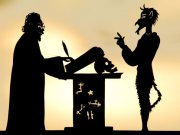
The thumbnail shows Dr Faust at home  receiving advice from the devil.
It is from the shadow theater at  http://www.vagantei-erhardt.de/index.html 


The Flood of Paper Money

Mephistopheles becomes the court jester of a bankrupt Emperor.

Overnight he prints a ton of paper money.  In the morning, the Emperor and all his subjects celelebrate their new wealth.

For additional entertainment, the Emperor asks Faust to bring in Antiquity's most famous beauty, Helen of Troy.** Faust asks Mephistopheles to go and fetch her up, but Mephistopheles bows out saying he is well acquainted with the Christian underworld, but not with Pagan institutions.
.

**
**Helen arrives from the beach speaking in free verse so beautiful that it makes (some) readers jump and shout olé. Heinrich Heine said it was the only good thing in that second part of Faust, but there he was wrong. 


**Added March 15, 2017
Yes, Heine was wrong, and it means necessarily that Heine did not read the later scenes, did not see them, "scrolled" too fast, for otherwise he would have taken his beret off to Goethe's story of the silver bell (I know that he did not enjoy bells in general, to him they were "Hundegebell" :-). -- And he would have enjoyed Goethe's invention of Mephistopheles getting cheated by the angels. -- All of this is hidden under miles of cheap verse.

Later,  Helen, coming home after many years travelling abroad, she is not sure whether her husband will behead her. She has no objections. (!)  Evidently, I will have to read this again, for I cannot believe it is really this way. 

**Added March 15, 2017
 No, it is true. Unbelievable. She is portrayed as supremely elegant, controlled, but she finds it possible that her husband asks her to get everything ready to be beheaded, including water to clean up the mess. And she accepts it silently, but then accepts help to escape. -- Socrates accepted deathsentence passed by anonymous citizen's majority vote, but then refused help and did not flee, but died.
........................................................................


Angels to Seduce Mephistopheles


Faust is dying, and Gretchen, from Heaven, sends angels to Faust's deathbed.

Mephistopheles, too, arrives to try and catch Faust's soul according to their agreement, and  he lets it escape because he gets dazzled by the splendour and beauty of the angels.

It is a good example of Goethe's cosy paganism. He turns the Christian view of death into a pretty joke.
___________________________________________


.

Text samples

Faust in his study room:  

Goethe's text beside a modern transcript:


___________________________________________


Goethe reached perfection in his verse so early and easily that later he must have felt bored. He ended up producing too much of it. To get to the end of Faust's life I had to scroll down, down down:


Death of Faust


Remember Faust's bet?

He had said that if ever he enjoyed any moment enough to let it linger, Mephistopheles could have his soul.
Well, Faust was still at the Emperor's court and had become powerful. He decided to push back the sea and claim the land for the many. Faust imagined that watching all those people take possession each of his plot would make him so happy that he might ask time to slow down....

The project was hampered by the little bell of a chapel that interfered with Faust's peace of mind and two old people who lived in a hut. Faust envied them and ordered that they should be paid off and removed.  When they objected, Mephistopheles had the place torched:

"Auch hier geschieht, was längst geschah,
    Denn Naboths Weinberg war schon da."
    https://www.biblegateway.com/passage/

It's Mephistopheles quoting Scriptures !
meaning "here, too, all is déjà vu, all is old news": to obtain the site, Mephistopheles means to kill the old couple as Ahab had done to obtain Naboth's vineyard.


When Faust heard that the two old people had been murdered, he cursed it all, but started on a new project and died.


.

Friday, August 9, 2013

Macbeth -- auf deutsch

. .


General Macbeth und sein Begleiter reiten vom Krieg heim und  treffen unterwegs auf drei Hexen.

Sie richten an Macbeth einen feierlichen Gruss als wäre er König Duncans Thronfolger.


Versión en español → → http://cantueso.wordpress.com/2010/02/21/macbeth/ 

English version  → →  http://espliego.wordpress.com/2008/04/08/macbeth/


Dieser Gruss bringt Macbeth auf Gedanken, die er sich nicht eingestehen kann.


Macbeth bespricht die Begegnung mit seiner Gattin. Sie bestärkt ihn in seinem Vorhaben.

Auf der Burg erwarten sie König Duncans Besuch, und sie ermorden ihn nachts im Schlaf.
.
............................................................................................................


Macbeth ist sich seiner Macht nicht sicher, und er begibt sich zu den drei Hexen um Rat.
Die Hexen singen und tanzen um den Kessel und orakeln, dass Macbeth nichts zustosse, solange der Schlosswald nicht gegen ihn vorrücke.

"Sei kühn und unbesorgt, denn du wirst nie besiegt, solang der Wald von Birnam sich  nicht feindlich deiner Burg nähert...."


Macbeth schliesst aus diesem Spruch, dass er auf immer in Sicherheit sei.


Von da an regiert er ohne Rücksicht aufs Gesetz, und die Aristokratie macht sich kriegsbereit. Getarnt mit Geäst und Laubwerk greifen sie Macbeth an.

Die Wache meldet, dass der Wald  sich in Bewgung setze.
Macbeth weist die Wache mit Spott ab.


............................................................................................................


Lady Macbeth wirkt  ihrem Gatten gegenüber resolut, aber sie bricht unter der Spannung zusammen und  kann nicht mehr schlafen.


Macbeth hat den Schlaf ermordet, sagt Shakespeare.
............................................................................................................


Bestbekanntes Zitat:

Macbeth sieht sich in Todesnähe und stempelt  das Leben als Geschichte ab, die wohl Lärm und Aerger, aber weiter nichts bedeutet:


"............Life is a tale
Told by an idiot, full of sound and fury
Signifying nothing." —

Das Zitat beginnt mit

"To-morrow, and to-morrow, and to-morrow,
Creeps in this petty pace from day to day...":

"Die Tage kriechen so einer um den andern penibel einher...."

............................................................................................................


Wer Macbeth zum ersten Mal liest, sollte zweitrangige Handlungsträger zunächst weglassen.  Macbeth ist  dann sehr viel leichter zu verstehen als jedes andere Drama von Shakespeare.


Die Wandtafel-Zeichnungen von ghD:
Die Hexen erhalten königlichen Besuch, denn Macbeth bittet um Abklärung des Orakels.

 ....................................................................................


Shakespeares Thatertechnik

Zwei Szenen des Dramas sind ohne Bezugsrahmen verständlich und zeigen, wie Shakespeare den dramatischen Verlauf mit Gaukelei und Hokuspokus bremst:


Auf diese Weise mässigt er die Spannung und unterbindet den sentimentalen Verschleiss des Dramas.


Torwart der Hölle:

Duncans Ermordung ist noch nicht entdeckt, und bei Tagesanbruch klopft es am Burgtor.

Der Pförtner tritt auf und spricht mit sich selbst; er sieht sich als Höllenwart, der Gäste jeder Art empfängt:


Uebersetzung von Dorothea Tieck


........................................................................


Das Gespenst des toten Generals

Macbeth gibt ein grosses Bankett zur Feier seiner Krönung.

Er hat General Banquo ermorden lassen, aber der ermordete General setzt sich als Gespenst zu den Gästen an den Tisch.

Nur Macbeth sieht ihn und spricht ihn mit Entsetzen an.

Die Gäste erschrecken, und Lady Macbeth versucht vergebens, die Situation zu retten.

http://www.william-shakespeare.de/macbeth/macbeth_3akt.htm

.........................................................................


tn_Scotland-Glamis-Castle.


Schloss Glamis in Schottland. Königin Elisabeth ist dort ihre Kindheit verbracht.

Glamis war einer von Macbeths Adelstitel.

................................................................................

Das Schloss von Macduff, bekannt als
St Andrew's Castle North Fife:


Photographiert von Jjhake und veröffentlicht unter CC Attribution-Share Alike 3.0 Unported license bei http://upload.wikimedia.org/wikipedia/commons/4/48/St_Andrews_Castle_Panorama.jpg ........................................................................................................................
.


Und dies ist Dunsinane Hill, vor fast 1000 Jahren Macbeths Festung:


.........................................................................................
.
Credits

Die erste Foto ist von http://p-pcc.blogspot.com/2007/04/throne-of-blood-1957.html --  Akira Kurosawa's Throne of Blood

Zwei weitere sind von Roman Polanski bei http://tinyurl.com/m4g62mx

.