Pages

Showing posts with label German. Show all posts

Wednesday, August 23, 2017

Franz Kafka: An Imperial Message


"Our land is so huge that no fairy tale can adequately deal with its size. Heaven hardly covers it all."


The photo: Chinesische Mauer by Bjoern Kriewald in public domain according to http://en.wikipedia.org/wiki/File:Chinesische-mauer.jpg

.................................................................................


Kafka's greatest and most explicit parable is about the Emperor of China. From his deathbed the Emperor is sending a personal message to you. You are his subject. --
Kafka explains why it will take infinitely long for this message to reach you :
"The Emperor—so they say—has sent a message, directly from his death bed, to you alone, his pathetic subject, [......]. He ordered the herald to kneel down beside his death bed and whispered the message to him........and had the herald repeat it back to him. He confirmed the accuracy of the verbal message......... -- But you sit at your window and  dream it up for yourself  when evening comes."

.
An Imperial Message  
complete in English


The translation is from the website of Ian Johnston . Ian Johnston gives most of his work to the  public domain to be used without charge and without permission, provided the source is acknowledged.

.................................................................................


Chinese Wall by gnu published at http://en.wikipedia.org/wiki/File:Chinese_Wall.JPG under the CC Attribution-Share Alike 3.0 Unported license.


.
The Imperial Message is a short parable included in the longer story of The Great Wall of China  available at
https://records.viu.ca/~Johnstoi/kafka/greatwallofchina.htm


Kafka had the idea to investigate why and how the Great Wall was originally meant as a foundation for the Tower of Babel. --  He had a doctorate in law and worked as an insurance lawyer, and in some of his texts that shows :-) -- as for instance in the following reflection:

"In fact, not only can such a wall not protect, but the structure itself is in constant danger. "

Remember in that regard Kafka's story of the mole that dug underground to create a really safe  place for himself ? He used all his strength in the construction. Exhausted when it was (nearly) complete, he reasoned that to feel really, really safe he had better not go inside at all, but watch it from the outside. -- 
The complete text is at http://pastebin.com/9rNJecsG. --  Copyright ?

.................................................................................

.
Kafka’s ultimate greatness is in his style. It shows in his parables and does not translate. Just as Hemingway set a standard for the English language, Kafka re-invented German on a level not reached since Goethe.


But, while Hemingway established a rather simple ideal of economy easy to grasp and imitate, Kafka expanded the language, its possibilities, its vocabulary and also its syntax more than anyone had ever done in prose including even Goethe who could only show his reach in verse.

.................................................................................
.
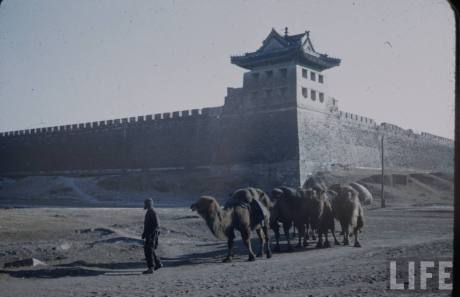
old beijing city wall


The old city wall of Beijing : the larger version of the photo is at http://www.studiolum.com/wang/chinese/kessel-beijing/004.jpg


Eine kaiserliche Botschaft
Der Kaiser, so heißt es, hat Dir, dem Einzelnen, dem jämmerlichen Untertanen,[....] gerade Dir hat der Kaiser von seinem Sterbebett aus eine Botschaft gesendet. Den Boten hat er beim Bett niederknien lassen und ihm die Botschaft zugeflüstert......... - Du aber sitzt an Deinem Fenster und erträumst sie Dir, wenn der Abend kommt.

The German text, complete:
Deutsche Fassung, ungekürzt von http://www.textlog.de/32053.html


.................................................................................
.


Many of Kafka's parables are depressing and can't be read just anytime, unless indeed they are very short and shocking like this one:

Give Up!


.................................................................


Franz Kafka
1883 – 1924 He described his father as

 "a true Kafka in strength, health, appetite, loudness of voice, eloquence, self-satisfaction, worldly dominance, endurance, presence of mind, [and] knowledge of human nature" (Wikipedia) .

Thursday, April 13, 2017

Martin Heidegger: Ansprache University Speech 1933

Rector´s Address -- Rektoratsrede  "Die Selbstbehauptung der deutschen Universität"-- Self-Assertion of the German University --1933 

..............................................................................................
The text is freely available in English at
 https://webspace.utexas.edu/hcleaver/www/330T/350kPEEHeideggerSelf-Assertion.pdf

und auf deutsch:
http://www.staff.uni-giessen.de/~g31130/PDF/polphil/Heidegger.pdf


Heidegger's metaphors

It is a political speech delivered in everyday language and much easier to read than his written work, and so there appears in broad daylight what made his philosophy so successful. It is his insidious, brilliant ease in the use of metaphor, as if he were just another Rilke. His metaphors are radiant summaries obliging the reader to stop and think.


http://dekluizenaar.mimesis.nl/?page_id=4131


"The beginning has invaded our future........"

.


Heideggers Metaphern

Es ist eine Rede mit politischem Inhalt, gar nicht zu vergleichen mit dem Nebelschleier von "Sein und Zeit". Man sieht sodann, was seiner Philosophie so ausschlaggebend weiterhalf: der Glitz seiner Metaphern, mit denen er wie ein zweiter Rilke allerhand Bedeutsamkeiten herzaubert.


..............................................................................................


Heidegger's sentimentalism

Besides that, there is his sentimentalism. If you cannot see it, you have already fallen for it. It isn't a trap, though, for it is everywhere and turns his writing into a swamp.

Sodann seine Sentimentalität. Wer sie nicht sieht, patscht darin herum. Sie macht aus jedem Text einen Sumpf.
..............................................................................................
.


The greatest thinker incl. moustache: "If we must be serious....".


Below is the jpg of the beginning in English und auf deutsch:


.


I read a little further  to find the metaphor quoted  plus this reference to Nietzsche with its conditioned recommendation to be serious about the idea that God is dead.


Notice that Heidegger does not say "seeker of God", but "seeker of the god" which isn't really fair to Nietzsche. It is a wee little cheat. Never mind.

--------------------------------------------------------------------------
.

Heidegger was a Nazi, but not a racist. At least in 1933 his prestige was big enough to allow him to discreetly stay away from that other orgy.

However, the ugly fact, which won't go away, is that in 30 years after the war he never even tried to face the disaster and to explain, no matter how tentatively, why Dachau "came into being" or why "neither modern political philosophy nor theology nor philosophy had the critical resources to respond to the disintegration of the liberal state." Introduction to Leo Strauss's "Spinoza's Critique of Religion" translated by Elsa M. Sinclair, New York: Schocken, 1965.
.

Heidegger war ein Nazi, hielt aber wenig auf  Rassentheorie. Wie definiert sich ein Nazi ohne Rassenbewusstsein? Bekannt is mir nur Susan Sontags Artikel über Leni Riefenstahl: http://www.nybooks.com/articles .

Da verbleibt jedoch die hässliche Tatsache, dass Heidegger volle 30 Jahre nach dem Krieg sich  nicht einmal versuchsweise zu einer Stellungnahme bereitfand. Die im "Sein und Zeit" ad hoc betriebene Sinnvernebelung reichte offenbar nicht so weit.

Heidegger lived until 1976, and as far as I know there wasn't a single analytical word to be heard from him in all that time on that one question which won't go away either.
.


Photo by Muesse at http://en.wikipedia.org/wiki/File:Heideggerrundweg0009.JPG under CC Attribution-Share Alike 3.0 Unported license.

.

Postscript December 2014

I found out only now that Heidegger himself thought he was indebted to Hoelderlin:  see http://dekluizenaar.mimesis.nl/ in de voetsporen van Heidegger.

I'll have to google elsewhere for a saying about "whitened sepulchre".
It's sickening. They are both
"whited sepulchres, inside full of dead men's bones and  filth."
Matthew 23:27


Friday, March 24, 2017

Goethe's Erlkönig


A father is riding home. In his arms he holds a child. The child complains about strange beings trying to get him. The father is frightened and rides faster, but when he gets home, the child in his arms is dead.

It is oppressive as a poem. The strange figures in the dark try to seduce the child. It is not typical of Goethe’s work, though he did bow to nature and believed in extrasensory perception. And all his life he collected stories and theories from occult sciences. For instance, he seriously thought that Napoleon’s greatness was of deamonic origin.

Even so, this poem sounds like Goethe only in its language. It is too spooky in other regards, and there is no humour. Critics have always hesitated to acknowledge that in the child’s hallucinations there is an allusion to rape. The poem can be remembered quite clearly and even analyzed without that allusion.

Faust I   features short moments of similar cruelty, and these aren’t readily remembered or recalled either.


.
Below is the original text in German and my prose translation -- where, too late, I saw the accidental rhymes in the first lines.


I believe that versed translations do more harm than good. They certainly give the wrong idea of Shakespeare and Heine, just like the attempted translations of a writing style that distort or masque Cervantes, Huckleberry Finn, Marcel Proust.

There is great poetry without rhymes, and if there are rhymes, they are not elements of  decoration, but functional and necessary like the waves of the sea. In translation they become mere imitation showing the translator's skill or his tolerance.


Versed translation 1 http://www.recmusic.org/lieder/get_text.html?TextId=6382
Who's riding so late through night, so wild?
It is the father who's holding his child;

Versed translation 2 http://ingeb.org/Lieder/werreite.html
Why is your face so frightened my son?
The King of elves, father, see him yon?              o o o p s!

Versed translation 3 http://dererlkonig.wordpress.com/translations/
Who rides there so late through the night dark and drear?
The father it is, with his infant so dear;

Some poet, for instance Bob Dylan or Heinrich Heine, would not want the rhymes = waves of his verse to be so soft and smooth, and  he goes and disturbs them :) -- But that's another story.

Bob Dylan quoted from http://www.bobdylan.com/us/songs/i-shall-be-free-no-10:
I am a poet
And I know it.
.
.

Tuesday, September 13, 2016

Faust vs a little Silver Bell


Towards the end of the play, Faust is still employed by the bankrupt emperor. Inflationary policies are tearing up public peace, and a war breaks out.

Faust becomes a General and wins the war thanks to Mephistopheles' sorcery.


Now Faust is almighty and he plans to build a giant system of dams to push back the sea. He is successful, except for one spot, where he is held back by a chapl and a wood hut with two old people who do not want to move.


And great Faust suddenly shows signs of  impatience. He complains that he cannot stand the pealing of the chapel's little bell.

The silver bell of that chapel keeps reminding him that the whole world would be his ....if only  he also owned that one spot, and he and Mephistopheles concord that the pealing of that ominous bell must be stopped at once.


Mephistopheles allows the place to be torched by his rude subordinates.

.............................................................................

FAUST admits he feels ashamed that such a little bell could upset him. --
Wie schaff ich es mir vom Gemüte! --
Das Glöcklein läutet, und ich wüte.
How can I get rid of it! The little bell rings, and I rage.

MEPHISTOPHELES:

It's natural that such a basic inconvenience would spoil your complete life. Who would dispute that!
Natürlich daß ein Hauptverdruß
Das Leben dir vergällen muß.
Wer leugnet's!

Auch hier geschieht, was längst geschah,
Denn Naboths Weinberg war schon da.

It is Mephistopheles quoting from the Bible saying that Naboth was killed for his vineyard, and whatever happened then, will happen again.


..............................................


The photos are at http://en.prolinefilm.ru/gallery/?sect_id=1afb3426, taken from a film interpretation of "Faust" directed by Alexander Sokurov.

Goethe himself had used a source from the Middle Ages.

Basically it's the story of a science teacher who tries to get out of the racket by making a deal with the devil.
Goethe's Mephistopheles is a lucid well-read old cynic and more astute in his reflections than Faust himself.
Of Sokurov's film I have only seen the stills.
Below is Sokurov's "Gretchen", the girl seduced by Faust with Mephistopheles' decisive help.

....................................................................................


From Wikipedia https://en.wikipedia.org/wiki/Faust

Origins of the Faust story

"The Faust of early books—as well as the ballads, dramas, movies, and puppet-plays which grew out of them—is irrevocably damned because he prefers human to divine knowledge; "he laid the Holy Scriptures behind the door and under the bench, refused to be called doctor of Theology, but preferred to be styled doctor of Medicine".

Plays and comic puppet theatre loosely based on this legend were popular throughout Germany in the 16th century, often reducing Faust and Mephistopheles to figures of everyday fun."
.
.

Friday, April 22, 2016

Goethe Faust -- erster Teil


Der Professor verflucht seine Buecher und Papiere. Er doziert privat diverse Wissenschaften und waere das Getue allzu gerne los, kann es sich aber nicht leisten. Er sucht daher das Hintertuerchen im Okkultismus und bastelt sogar an einer Idee vom Tod als Moeglichkeit
 
Auf neuer Bahn den Äther zu durchdringen,
Zu neuen Sphären reiner Tätigkeit.
die Pforten aufzureißen,
Alexander Sokurov

 
Mit einem klassisch gereimten kühnen Trinkerspruch will er sein Kraemerdasein verlassen, doch ist es nun Ostermorgen und der Gesang der Engel haelt ihn ab.

English Version ... http://cantueso1.blogspot.com.es/2015/03/f-u-s-t-story.html


Das Arrangement mit Mephistopheles

Auf einem Spaziergang folgt ihm ein schwarzer Pudel und begleitet ihn mit allerlei Possen ins Studienkabinett. 

Faust:
Ist es Schatten?  ist's Wirklichkeit?
Wie wird mein Pudel lang und breit!
 
Welch ein Gespenst bracht ich ins Haus!
Schon sieht er wie ein Nilpferd aus,
 .
Aus dem Hund wird naemlich Mephistopheles, Goethes eigenster Ersatz fuer den christlichen Teufel.

Mephistopheles  ist ein aelterer Herr, philosophisch solvent, welterfahren und zudem elegant in Sprache und Kleidung. Dr Fausts wissenschaftlichen Bemuehungen gegenueber aeussert er sich schnippisch unverbindlich und wettet mit ihm um seine Seele:

Mephistopheles:  Ich gebe dir, was noch kein Mensch gesehn.

Faust:
          Kannst du mich mit Genuß betrügen-
          Das sei für mich der letzte Tag!
 
Mephistopheles:  Topp!

Faust:
  Werd ich zum Augenblicke sagen:
  Verweile doch!  du bist so schön!
  Dann magst du mich in Fesseln schlagen,
  Dann will ich gern zugrunde gehn!

........................................................................


Unterwegs mit Mephistopheles

Sie verreisen und gelangen in einem Bierkeller zu einer Runde grober Zecher.

  Siebel:
  Will keiner trinken?  keiner lachen?
  Ich will euch lehren Gesichter machen!
 
  Brander:
  Das liegt an dir; du bringst ja nichts herbei,
  Nicht eine Dummheit, keine Sauerei.

  Siebel: (giesst ihm ein Glas Wein über den Kopf):
  Da hast du beides!

  Brander:
  Doppelt Schwein!

Mephistopheles bohrt für die Gesellen je ein Loch in den Holztisch und sogleich fliesst nach freier Wahl fuer jeden der beste Wein.

Faust verweist Mephistopheles auf ihre Wette, da er seine Seele eben nicht für solchen Unsinn verkauft habe. Zusamen suchen sie eine Hexe auf, und Faust trinkt ihren Tee, mit dem ihm jedes weibliche Wesen übersinnlich schön vorkommen wird.

Begegnung mit Gretchen
 
So verliebt Faust sich nun in ein hübsches armes Mädchen namens Grete.
.


Um sie zu beschenken, muss Mephistopheles vorerst aus der Tiefe der Erde einen königlichen Schmuck heben, sodann muss Mephistopheles sich bei Gretes Nachbarin anbiedern, damit sie ein Rendez-vous in ihrem Garten ermöglicht,  weiter soll Mephistopheles jene Nachbarin mit Geplänkel unterhalten, und er erfährt, dass Gretchens fromme Mutter den Schmuck in die Kirche gebracht hat:

Mephistopheles:      
Denkt nur, den Schmuck, für Gretchen angeschafft,
       Den hat ein Pfaff hinweggerafft!
  
Faust:
Sei, Teufel, doch nur nicht wie Brei,
  Und schaff einen neuen Schmuck herbei!
...........................................................................
.

Grete ist schwanger und in ihrer Verzweiflung ertränkt sie das Kindchen. 

Alexander Sokurov


Die Sache spricht sich herum, Grete wird verhaftet und erwartet im Zwinger die Todesstrafe.

Mephistopheles bemerkt lakonisch: sie ist verdammt.
Vom Himmel kommt die Antwort: sie ist gerettet.


Damit endet Faust, der erste Teil, und der ist fluessig und leicht zu lesen, wenistens auf deutsch.

Bester Anfang hier:
http://gutenberg.spiegel.de/buch/faust-eine-tragodie-3664/4

Saturday, March 26, 2016

Kant: What is Enlightenment ?


Kant's  Critique is a wonderful book, full of great things like an old museum where they had to fire the caretaker because there aren't any visitors anymore. Things have suffered neglect. How could he end up referring to people as “domestic cattle” ? 

Below is a translation (at Gutenberg in public domain), but I did look up the original German text, and it is just as coarse.
 
Another odd novelty was to read Kant saying “it is more nearly possible, however, for the public to enlighten itself.”  --

Really? Consider the effort it takes,  now,  for anyone to stay his course in the flood of print. In Kant’s time there was less of that, but,  for other reasons, then as now, most people’s formation also depended largely on circumstantial luck.
.....................................................................


In fact, I had seen an even more shocking thing some years before. The jewel and conclusion of his        Critique is his final statement that “in these matters” (religion) nature has given every man the same possibilities of knowledge.

Nature as Deus ex maquina!  Nature, always so kind, considerate and full of foresight and killing people by the million?
In Spain they would say:


"Para este viaje no hacían falta alforjas" : 

“for this trip we did not need the saddle bags”, meaning the  result does not justify our exertions, as Kant also had anticipated.
....................................................................


Kant's Enlightenment essay is long and ends in yet another damper:

In a hagiagraphic allusion to Frederick II he says that this ruler can grant freedom of speech because he has a disciplined strong army allowing him to say:
 “Argue as much as you like and about whatever you like; only obey!”

Aber auch nur derjenige, der ............................ ein wohldiszipliniertes zahlreiches Heer ..... zur Hand hat, – kann das sagen, was ein Freistaat nicht wagen darf: Räsonniert, soviel ihr wollt, und worüber ihr wollt; nur gehorcht!
............................................................................

These are ominous discoveries, and maybe they were not meant the way I have understood them.


.
.

Tuesday, March 8, 2016

Bruegel: Die Sprichwörter

 .


.
6) Der eine schert Schafe, der andere Ferkel -- der eine lebt im Überfluss, der andere in Not

8) Dem Mann einen blauen Mantel umhängen -- ihn betrügen

>>> >> English version >>> >>  http://espliego.wordpress.com/2010/09/13/bruegels-proverbs-painting/
 
9) Er schüttet den Brunnen zu, nachdem das Kalb ertrunken ist  -- es wird erst etwas unternommen, wenn es zu spät ist

10) Rosen oder Perlen vor die Säue werfen -- Verschwendung an Unwürdige


.


.


.

21) Er hängt der Katze die Schelle an  -- ein Unternehmen ausposaunen und dadurch gefährden

33) Er trägt das Licht im Korb an den Tag --seine Zeit nutzlos vertun

34) Kerzen für den Teufel anzünden  -- sich jedermann zu Freunden machen

35) Beim Teufel in die Beichte gehen -- seinen Feinden Geheimnisse anvertrauen

43) Er pisst gegen den Mond  -- er strengt sich an, Unmögliches zu erreichen

46) Der große Fisch frisst den kleinen.

Quellennachweis
Dies Erläuterungen stehen unter CC Attribution-Share Alike 3.0 Unported Lizens bei http://commons.wikimedia.org/wiki/File:Bruegel6.jpg


--------------------------------------------------------------
.

Bruegel malt mit Vorliebe ländliche Tölpel, und er sieht sie als komisch geschäftig, grausam oder blödsinnig.
Sie entstellen mit ihrem Dasein die Traumlandschaft des weiten Horizonts im Hintergrund.


Es heisst, Bruegel sei manchmal inkognito an einer Hochzeit erschienen, um Ideen für seine Gemälde einzuholen.

Er sieht die Leute als Bestien, düster, unheimlich, und vertieft sich in jedes ihrer Gesichter. Nur reiche Leute sehen anständig aus. Selbst kleine Kinder sind stumpfsinnig.

Aber erstaunlicherweise  heisst es  im englischsprachigen Wikipedia, Bruegel sei Landschaftsmaler -- während im deutschsprachigen Wikipedia kommt
"er führte die flämische Landschaftsmalerei des 16. Jahrhunderts auf ihren Höhepunkt, begründete das niederländische Bauerngenre

Hier sind zwei kleine Hochzeitsgäste:


Man sieht zwar die Augen nicht, aber Haltung und Kleidung und jener Finger im Mund lassen vermuten, was das untere Bild mehr sichtbar macht:

Im kleinen Kind steckt bereits der zukünftige Tölpel.

Keine sehr katholische Vorstellung.
Hat Bruegel sich vor der Inquisition zu fürchten ?

Vielleicht hat er sich daher als Landschaftsmaler einschreiben lassen :-)
Warum weiss man von seinem Leben fast nichts? Und verwechselt ihn mit anderen Malern seiner Familie?

 .


..................................................................................................

Im Prado Museum in Madrid hängt sein berühmtes Bild:

Der Triumph des Todes 


.

Die Toten gehen in militärischer Formation gegen die Lebenden vor.
Noch immer sind da viele am Leben, aber retten können sie sich nicht. Sie unterliegen einer nach dem andern der sinnlosen Uebermacht des Todes.

Ein altes Pferde zieht einen Wagen voller Skelette und tötet unterwegs, was sich da etwa noch bewegt.

Im fernen Hintergrund des Gemäldes ragen Galgen zum Himmel empor und am Horizont brennen Schiffe. 
.


Thursday, July 30, 2015

N i e t z s c h e


.
....
Location_Switzerland_Europe

Nietzsche taught at the university of Basel, Switzerland, a serious Protestant city which every spring explodes in a carnival of incredible noise, music, beauty, and nonsense, one week late and at 4 a.m. You would not believe your ears if you were there and didn't know, but would hear lots of people running and whispering in the street as if preparing a coup d´Etat.


So Nietzsche called the industrious city of Basel "the Colourful Cow", "die bunte Kuh" because of the contrast between its silent industrious life and that carnival.
This was in the second half of the 19th century.
.....................................................................

.
Nietzsche's Philosophy
.
Nietzsche taught that reason is some sort of biochemical accident that can't last, because it is at odds with the forces of nature. Reason tries to overcome and stifle nature and thereby brings about its own destruction. --

This would be what many or even most people believe now, though not consciously, not formulated either.

However, Nietzsche is most famous for his attacks on religion. He wrote that God was dead and therefore the "superior human" had to take over to save the West from the spread of nihilism. That "superior human" is not defined by race, but by willpower.


As a philosopher he has been read and studied by many more people than will admit it, but his premises are really not compatible with our laws, our ethics and their Biblical origins, and so the academic talk about him has mostly been vapid or uneasy.
.
Quote : Is man God's blunder? Or is God a blunder of man's?
 ........................................................................

Nietzsche lived from 1844 to 1900.

Nobody read his last works until some time after his death, when the Nazis set him up as their thinker. After WWII his reputation had to be repaired. And then, in the sixties, he and Sartre were all the talk. He remains more readable than any of the great philosophers :

"In irgend einem abgelegenen Winkel des in zahllosen Sonnensystemen flimmernd ausgegossenen Weltalls gab es einmal ein Gestirn, auf dem kluge Thiere das Erkennen erfanden. Es war die hochmüthigste und verlogenste Minute der "Weltgeschichte": aber doch nur eine Minute." 
.


"In some remote corner of one of the innumerable solar systems of the universe there was once a star where some clever animals invented Knowledge. It was the most arrogant and mendacious minute of history, but even so only a minute...."

Nietzsche saw most of man's history as an ongoing party where everyone wears a masque and a costume.
.
"You'd have to write a fable to illustrate how [....] aimless our reason appears in nature. There have been eternities when it did not exist; and when it disappears nothing will have happened."

His most famous friend was Lou Salomé.

The best Nietzsche texts, easy, clear and even frank, are his letters at Wikisource.

https://en.wikisource.org/wiki/Selected_Letters_of_Friedrich_Nietzsche

where you see him, from the time he writes home to Mom, until 30 years later, in 1889, when  he breaks down, still writing as a visionary, but mad.
The letter collection "My sister and I", sold as Nietzsche´s correspondence with his sister, is forged.

.
Aged 45 Nietzsche collapsed mentally and did not recover. However, he has always been loved best precisely for his later, pigheaded writings and the "abyss" you stare down.


.....................................................................

Nietzsche's Background

.
But this was Nietzsche's home town : solid, simple, honest and hard-working. Doesn't this architecture show it?
.
Roecken church

http://www.friedrichnietzsche.de/friends_of_roecken/main_eng.htm.


Location_Germany_EU_Europe

Nietzsche was the son of a pastor at Röcken in Germany, and he started out as a philologist studying and teaching about the Greeks.
He should be read as a pastor. He preached and his message was that life without God must be taken much more serious to show its meaning.
.

.
http://www.jenakolleg.de/tagesausflug-nach-leipzig-am-10-oktober-2009.html

The house to the right is where Nietzsche was born, and I think (but could not confirm it) that the church in the background is where Nietzsche's father preached.
Look at this architecture and consider what an orderly, intelligible little world that was.
And yet Nietzsche pronounced it a hoax.
.

 http://www.leipzig-lese.de/files_leipzig_lese/nietzsche_kirche_mit_gr__bern.jpeg


In the ground beside the church, just barely visible in the photo, there are the graves of Nietzsche and his sister.
.................................................................
.


I thought this was the greatest portrait of the young Nietzsche.

However, according to an e-mail received from Gabrio Bevilacqua,the photo is not of Nietzsche, but of King Umberto I of Savoy who was assassinated in 1899.

This is the young Nietzsche:
.
http://jacketmagazine.com/31/stephens-nietzsche.html


There is a complete collection of his works free, but poorly translated at http://www.openculture.com/2014/11/download-nietzsches-major-works-as-free-ebooks.html 
..........................................................................................

Postscript

I have seen but not yet read almost any Strauss on Nietzsche, but was shocked to see admiration openly admitted.
Nietzsche deserves it, but not unqualified, because he, unlike Goethe and Shakespeare, omitted to call to mind the simple idealogical safeguard against things like Hitler or Stalin which is the question of proportion:

How can an individual figure out a way to simplify or clarify existence for a thousand million  people?

Goethe's Faust was defeated when he uselessly cursed the little chapel bell trying to warn him -


Tuesday, March 17, 2015

F a u s t -- The Story


Faust

The Deal with Mephistopheles

Faust curses his books and his papers and wishes he could get out. He is a university teacher. He  considers suicide but is held back by childhood memories.

A few weeks later, around Easter, he goes out for a walk. A black poodle follows him home. The black poodle turns out to be Mephistopheles -- Faust's own Greek version of the devil.

Mephistopheles is a most entertaining elderly cynic dressed up as a gentleman who has come to offer Faust a deal: "I will show you the wonders of the world, and in return, when you die, I will intercept your soul when it leaves your body."

Faust accepts.


........................................................................


Traveling with Mephistopheles

They travel and end up at a beer cellar where Mephistopheles produces free wine for everybody by drilling holes in their table.  Faust tells Mephistopheles that he did not sell his soul for that kind of show.


So Mephistopheles has to work hard to help him seduce a teenage girl called Gretchen who gets pregnant


and in despair drowns her baby. She faces the death penalty. Mephistopheles comments: "She is damned".
From Heaven comes an answer: "She is saved".


Isolde Dychauk as Gretchen


 That is where the first part ends. It is easy and great reading........ but only in German

........................................................................


Faust II

Even Goethe said he knew it was too difficult for most readers, because it is full of Greek mythology and German witchcraft, but I did read its most famous passages:

at the time when I wrote this I had only read the most famous passages.
.


The thumbnail shows Dr Faust at home  receiving advice from the devil.
It is from the shadow theater at  http://www.vagantei-erhardt.de/index.html 


The Flood of Paper Money

Mephistopheles becomes the court jester of a bankrupt Emperor.

Overnight he prints a ton of paper money.  In the morning, the Emperor and all his subjects celelebrate their new wealth.

For additional entertainment, the Emperor asks Faust to bring in Antiquity's most famous beauty, Helen of Troy.** Faust asks Mephistopheles to go and fetch her up, but Mephistopheles bows out saying he is well acquainted with the Christian underworld, but not with Pagan institutions.
.

**
**Helen arrives from the beach speaking in free verse so beautiful that it makes (some) readers jump and shout olé. Heinrich Heine said it was the only good thing in that second part of Faust, but there he was wrong. 


**Added March 15, 2017
Yes, Heine was wrong, and it means necessarily that Heine did not read the later scenes, did not see them, "scrolled" too fast, for otherwise he would have taken his beret off to Goethe's story of the silver bell (I know that he did not enjoy bells in general, to him they were "Hundegebell" :-). -- And he would have enjoyed Goethe's invention of Mephistopheles getting cheated by the angels. -- All of this is hidden under miles of cheap verse.

Later,  Helen, coming home after many years travelling abroad, she is not sure whether her husband will behead her. She has no objections. (!)  Evidently, I will have to read this again, for I cannot believe it is really this way. 

**Added March 15, 2017
 No, it is true. Unbelievable. She is portrayed as supremely elegant, controlled, but she finds it possible that her husband asks her to get everything ready to be beheaded, including water to clean up the mess. And she accepts it silently, but then accepts help to escape. -- Socrates accepted deathsentence passed by anonymous citizen's majority vote, but then refused help and did not flee, but died.
........................................................................


Angels to Seduce Mephistopheles


Faust is dying, and Gretchen, from Heaven, sends angels to Faust's deathbed.

Mephistopheles, too, arrives to try and catch Faust's soul according to their agreement, and  he lets it escape because he gets dazzled by the splendour and beauty of the angels.

It is a good example of Goethe's cosy paganism. He turns the Christian view of death into a pretty joke.
___________________________________________


.

Text samples

Faust in his study room:  

Goethe's text beside a modern transcript:


___________________________________________


Goethe reached perfection in his verse so early and easily that later he must have felt bored. He ended up producing too much of it. To get to the end of Faust's life I had to scroll down, down down:


Death of Faust


Remember Faust's bet?

He had said that if ever he enjoyed any moment enough to let it linger, Mephistopheles could have his soul.
Well, Faust was still at the Emperor's court and had become powerful. He decided to push back the sea and claim the land for the many. Faust imagined that watching all those people take possession each of his plot would make him so happy that he might ask time to slow down....

The project was hampered by the little bell of a chapel that interfered with Faust's peace of mind and two old people who lived in a hut. Faust envied them and ordered that they should be paid off and removed.  When they objected, Mephistopheles had the place torched:

"Auch hier geschieht, was längst geschah,
    Denn Naboths Weinberg war schon da."
    https://www.biblegateway.com/passage/

It's Mephistopheles quoting Scriptures !
meaning "here, too, all is déjà vu, all is old news": to obtain the site, Mephistopheles means to kill the old couple as Ahab had done to obtain Naboth's vineyard.


When Faust heard that the two old people had been murdered, he cursed it all, but started on a new project and died.


.

Friday, May 30, 2014

Leo Strauss: Aristoteles und Moderne


1 -- Leo Strauss erklärt Aristoteles


Der Mensch als einziges irdisches Lebewesen neigt zu Glücklichkeit, und er ist zu Glücklichkeit  befähigt.

Das ist so, weil er als einziges Tier Verstand und Sprache besitzt [....]; seine Seele is gewissermassen “das All”: der Mensch ist Mikrokosmos.


English version: 

Es besteht eine natürliche Harmonie zwischen dem All und dem menschlichen Gemüt . Der Mensch wäre nicht zu Glücklichkeit befähigt, wenn das All, dem er zugehört, ihm nicht freundlich gesinnt wäre.

Diese Auffassung von der Beziehung zwischen dem Menschen und dem All wäre “Optimismus” im ursprünglichen Sinn: die Welt ist die bestmögliche der Welten.


The picture is of Phyllis riding on Aristotle from a story preached and popular in the Middle Ages.
 -- Below :


Public domain according to http://en.wikipedia.org/wiki/Casket_with_Scenes_of_Romances_%28Walters_71264%29#/media/File:French_-_Casket_with_Scenes_of_Romances_-_Walters_71264.jpg   
von links nach rechts: Aristoteles als Lehrer von Alexander; Phyllis reitet auf Aristoteles und Alexander sieht von oben zu; rechts: aeltere Leute beim Bad im Brunnen der Ewigen Jugend.

-----------------------------------------------------------------
.

2 -- Strauss vergleicht Aristoteles und Moderne:


Der Glaube an diese Harmonie erscheint nun als Wunschvorstellung oder als gutwillige Annahme.*** Rechnen müssen wir nun mit der Möglichkeit einer Welt als Werk eines bösen betrügerischen Geistes  [.......] oder einer blinden Notwendigkeit.

Kennzeichnend fürs moderne Denken ist folgerichtig der Entschluss, den Menschen zu befreien und die Natur feindlich zu unterwerfen.
Damit ist die Weissenschaft nun, statt stolzer Betrachtung, ein Versuch dem Menschen das Los zu erleichtern.  Wissenschaft dient der Macht.

Das bedeutet jedoch, dass die Natur den Menschen nötigt, in Gemeinschaft zu leben; nur aus Furcht vor dem gewaltsamen Tod als grösstes Uebel kann der Mensch sich nötigen, Bürger zu werden und Bürger zu sein.

Dies wäre der Ursprung der von Nietzsche erkannten, asketischen Wesenszüge der modernen Moral.

(Ich habe nicht verstanden, wie man “aus Angst vor einem gewaltsamen Tod” Bürger wird, aber dies klärt sich sicherlich mit ein wenig mehr Lektüre. Gemeint ist doch nicht etwa der prähistorische Mensch den wilden Tieren gegenüber? Ich glaube jedoch, dass “die Furcht vor einem gewaltsamen Tod als grösstes Uebel”  nicht von Strauss ist, und dass Strauss die Vorstellung sogar abweist.)

Nachtrag:
Tatsächlich. Es  ist ein  Konzept aus Hobbes Leviathan.


https://www.google.com/?hl=en#hl=en&q=fear+violent+death+as+greatest+evil
or http://tinyurl.com/pe5skas


.......................................................................................
.

***
"Der Glaube an diese Harmonie erscheint nun als Wunschvorstellung oder als gutwillige Annahme."

Strauss schreibt häufig ironisch.
Wahrscheinlich beschreibt er diskret auf diese Weise die moderne Auffassung als wesentlich böswillig.

Warum sagt er’s denn nicht klar und deutlich?

Er sagte es schon anderswo, in einem anderen Buch, das schwer zu lesen ist.


Ergänzt am 5. Februar, 2014

Ich sah es erneut gestern in einer unveröffentlichten Vorlesung über Kant in schlechter, aber nicht unmöglicher Abschrift. Hier ist das Zitat:


Uebersetzt:

Wenn Gott demnach die Ursache aller Dinge ist, dann besteht offensichtlich eine Verwandtschaft zwischen dem Höchsten im Menschen und Gott als intelligentem Wesen.

Wenn aber das Höchste im Sinne des Ursprungs aller Dinge die blinden Atome in ihrer Bewegung  sind, dann ist offensichtlich das Höchste im Menschen nicht mit deren Höchstem verwandt.
Dies ist allerdings ein grosses Problem für jeden Menschen.

http://archive.org/search.php?query=leo%20strauss%20AND%20mediatype%3Atexts
 .......................................................................................

.
Leo Strauss ist in deutscher Sprache entweder nicht erhältlich oder schwer zu finden.  -- Schade. -- Niemand wie er geht auf heikle Themen ein oder bringt sie sogar  zur Sprache.


? ? !

https://www.metzlerverlag.de/buecher/leseproben/978-3-476-02264-6.pdf.

Added December 2015

Leo Strauss in deutscher Sprache ?

Zitat Brief an Löwith 1933


one doesn’t choose a homeland and, above all, a mother tongue, and in any event I will never be able to write other than in German, even if I must write in another language. On the other hand, I see no acceptable possibility of living under the swastika -
"Man kann seine Heimat und vor allem seine Muttersprache nicht wählen, und jedenfalls werd' ich nie anders als auf deutsch schreiben koennen, selbst wenn ich in einer anderen Sprache schreiben muesste. Andererseits - ich sehe keine ertraegliche Lebensmoeglichkeit unter der Swastika"

Ich weiss nicht, warum man ausgerechnet diesen Brief zitiert, um Strauss als crypto nazi hinzustellen -- etwa weil er fuer die Groesse Roms schwaermte ??


Tuesday, January 14, 2014

Leo Strauss: Der Mann aus Missouri


Die folgende Kurzfassung ist teils Zitat, teils Paraphrase frei übersetzt.
Strauss schreibt häufig ironisch; entsprechende Absätze sind eingerückt und distanzierende Vokabeln in negrita markiert .

An English version of this post  is at Leo Strauss: The Man from Missouri

Leo Strauss kam auf die Idee, dass die modernen Geistes-und Sozialwissenschaften mit ihrem Verzicht auf den "gesunden Menschenverstand" sich  unter Platos Höhle ein Kellerloch graben und ohne Hilfe nicht mehr rauskraxeln.
:-(

Nach Strauss sind die Methoden und Vorstellungen der Naturwissenschaften für die Erforschung des menschlichen Daseins nicht brauchbar.

Der ursprüngliche Text "An Epilogue" befindet sich bei http://archive.org/stream/LeoStraussAnEpilogue/LeoStrauss-AnEpilogueintegral_djvu.txt


.................................................. ..................................................


1

Der "Mann aus Missouri" ist der sprichwörtliche Empirist. Er weiß, dass er die Dinge und Menschen sieht, wie sie wirklich sind.
Er hält es für selbstverständlich, dass er mit anderen Menschen jeder Art in der gleichen Welt lebt, wo man einander auch irgendwie versteht.

2
In dieser Hinsicht würde die frühere politische Wissenschaft  mit dem "Mann aus Missouri" nicht streiten.
Eine einfache Feststellung aber zeigt, dass der "Mann aus Missouri" "naif" ist, weil er ja statt Dingen oder Menschen nur Farben und Formen, also bloße Sinnesdaten sieht.
Er würde jedoch Menschen und Dinge sehen, wenn er eine Gabe der "übersinnlichen Wahrnehmung” hätte.

Sowie er diesen Einwand hört, kratzt der "Mann aus Missouri" sich am Kopf. Mit seinem Schweigen bleibt er auf seine Weise Philosoph.


3
Das Problem liegt darin, dass die neue politische Wissenschaft sich entfaltet, indem sie den Bruch mit dem gesunden Menschenverstand anstrebt, aber nicht folgerichtig durchsetzen kann, wie es allgemein die folgende Überlegung aufweist:

>> Der Empirismus lässt sich nicht empirisch begründen;

>> Es ist nicht durch Sinnesdaten bekannt, dass der einzig mögliche Gegenstand der Wahrnehmung Sinnesdaten sind.


4
Jene Sinnesdaten sind Ergebnis einer Abstraktion und setzen die Rechtmässigkeit (Legitimität) unseres primären Bewusstseins von Dingen und Menschen voraus.


5
Dies bedeutet, dass die Naivität des Mannes aus Missouri sich nicht  vermeiden lässt. Es gibt kein Denken, das nicht letztendlich auf der Rechtmässigkeit dieser Naivität basiert.


6
Zwar wird niemnd bestreiten, dass das  vorwissenschaftlich politische Denken  echtes Wissen enthält, aber leider verbindet sich jenes Denken mit Spuk und Aberglauben.  Indem wir mit dem vorwissenschaftlichen Denken brechen, verabschieden wir irreführende Elemente.


7
Der gesunde Menschenverstand enthält in der Tat echte Kenntnis von Besen, aber leider  nimmt jenes Wissen im gesunden Menschenverstand den gleichen Rang ein wie das angebliche Wissen über Hexen. Im Vertrauen auf den gesunden Menschenverstand riskiert man demnach, das ganze Reich der Finsternis samt Thomas von Aquin zurückzubringen.


8
Wer das Vertrauen auf den gesunden Menschenverstand in empirischen Aussagen sieht, hat das fundamentale Rätsel zwar erkannt, aber doch nicht etwa gelöst. Es sollte aber niemanden peinlich berühren, wenn er zugeben muss, dass er für das grundlegende Rätsel keine Lösung hat.


9
Zu bestreiten, dass da überhaupt ein Rätsel vorliegt, ist als Lösung dürftig ausgedacht. Sicherlich findet sich keiner damit unter der Drohung ab, er sei halt sonst ein "Metaphysiker".


10
Um den weniger handfesten Kollegen gegen diese Bedrohung beizustehen, könnte man sagen, dass die Empiristen  glauben,  die Naturwissenschaften seien unendlich fortschrittsfähig, womit sie doch ebenfalls ein unlösbares Rätsel des Seienden voraussetzen.
................................................................................


Postscript "Kellerloch":

Kardinal J. Ratzinger schrieb zu einem ähnlichen Sachverhalt, es versuche einer, sich an den eigenen Schuhbändeln hochzuziehen. Zitat gesucht und noch nicht gefunden.
.


.