Pages

Showing posts with label philosophy. Show all posts

Wednesday, August 23, 2017

Franz Kafka: An Imperial Message


"Our land is so huge that no fairy tale can adequately deal with its size. Heaven hardly covers it all."


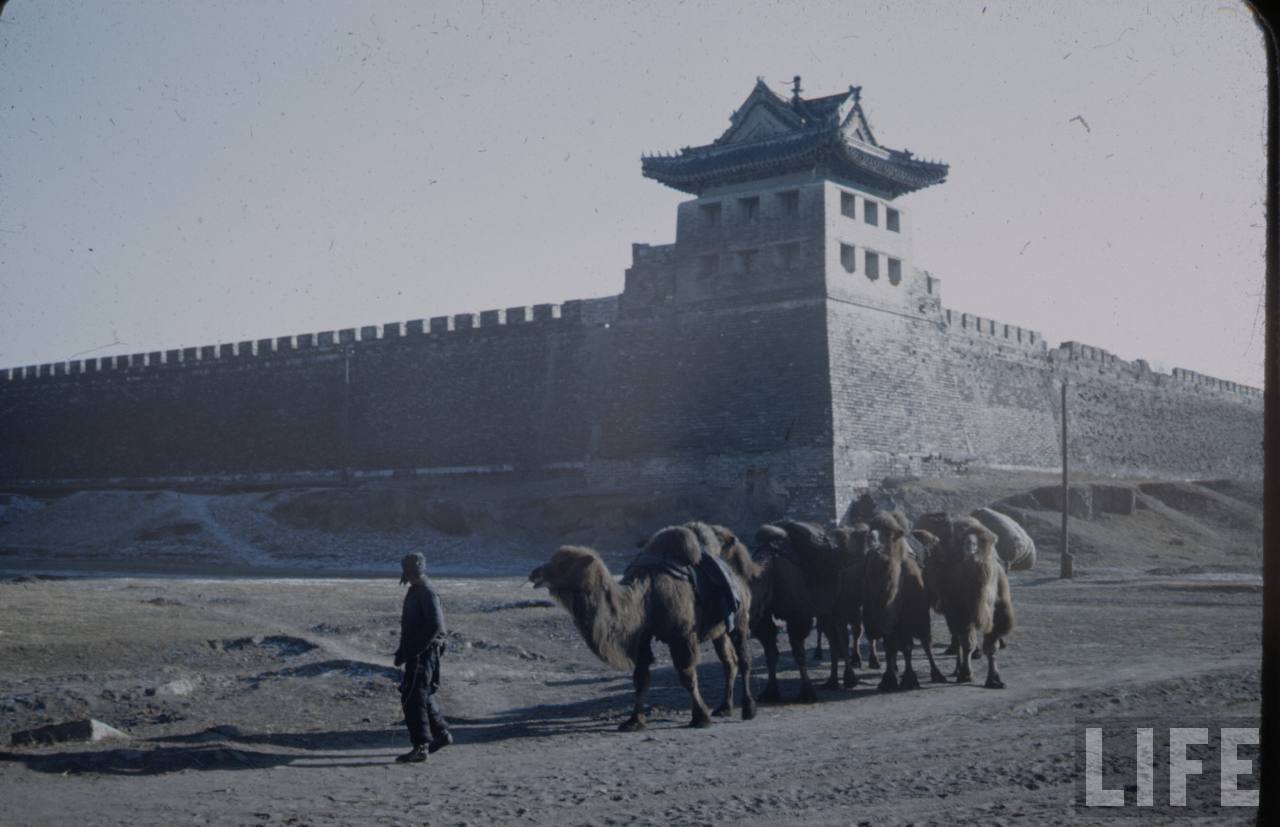
The photo: Chinesische Mauer by Bjoern Kriewald in public domain according to http://en.wikipedia.org/wiki/File:Chinesische-mauer.jpg

.................................................................................


Kafka's greatest and most explicit parable is about the Emperor of China. From his deathbed the Emperor is sending a personal message to you. You are his subject. --
Kafka explains why it will take infinitely long for this message to reach you :
"The Emperor—so they say—has sent a message, directly from his death bed, to you alone, his pathetic subject, [......]. He ordered the herald to kneel down beside his death bed and whispered the message to him........and had the herald repeat it back to him. He confirmed the accuracy of the verbal message......... -- But you sit at your window and  dream it up for yourself  when evening comes."

.
An Imperial Message  
complete in English


The translation is from the website of Ian Johnston . Ian Johnston gives most of his work to the  public domain to be used without charge and without permission, provided the source is acknowledged.

.................................................................................


Chinese Wall by gnu published at http://en.wikipedia.org/wiki/File:Chinese_Wall.JPG under the CC Attribution-Share Alike 3.0 Unported license.


.
The Imperial Message is a short parable included in the longer story of The Great Wall of China  available at
https://records.viu.ca/~Johnstoi/kafka/greatwallofchina.htm


Kafka had the idea to investigate why and how the Great Wall was originally meant as a foundation for the Tower of Babel. --  He had a doctorate in law and worked as an insurance lawyer, and in some of his texts that shows :-) -- as for instance in the following reflection:

"In fact, not only can such a wall not protect, but the structure itself is in constant danger. "

Remember in that regard Kafka's story of the mole that dug underground to create a really safe  place for himself ? He used all his strength in the construction. Exhausted when it was (nearly) complete, he reasoned that to feel really, really safe he had better not go inside at all, but watch it from the outside. -- 
The complete text is at http://pastebin.com/9rNJecsG. --  Copyright ?

.................................................................................

.
Kafka’s ultimate greatness is in his style. It shows in his parables and does not translate. Just as Hemingway set a standard for the English language, Kafka re-invented German on a level not reached since Goethe.


But, while Hemingway established a rather simple ideal of economy easy to grasp and imitate, Kafka expanded the language, its possibilities, its vocabulary and also its syntax more than anyone had ever done in prose including even Goethe who could only show his reach in verse.

.................................................................................
.
old beijing city wall


The old city wall of Beijing : the larger version of the photo is at http://www.studiolum.com/wang/chinese/kessel-beijing/004.jpg


Eine kaiserliche Botschaft
Der Kaiser, so heißt es, hat Dir, dem Einzelnen, dem jämmerlichen Untertanen,[....] gerade Dir hat der Kaiser von seinem Sterbebett aus eine Botschaft gesendet. Den Boten hat er beim Bett niederknien lassen und ihm die Botschaft zugeflüstert......... - Du aber sitzt an Deinem Fenster und erträumst sie Dir, wenn der Abend kommt.

The German text, complete:
Deutsche Fassung, ungekürzt von http://www.textlog.de/32053.html


.................................................................................
.


Many of Kafka's parables are depressing and can't be read just anytime, unless indeed they are very short and shocking like this one:

Give Up!


.................................................................


Franz Kafka
1883 – 1924 He described his father as

 "a true Kafka in strength, health, appetite, loudness of voice, eloquence, self-satisfaction, worldly dominance, endurance, presence of mind, [and] knowledge of human nature" (Wikipedia) .

Friday, August 4, 2017

Little Proust Bravely Facing his Parents


One evening, because of a visit,  his mother did not come upstairs to say goodnight and, after waiting for a long time,  Proust decides to write "a line" and have a servant bring it to her. But ......
I realised that, by writing that line to Mamma [...], I had cut myself off from the possibility of going to sleep until I actually had seen her
and my heart began to beat more and more painfully as I increased my agitation by ordering myself to keep calm and to acquiesce in my ill-fortune.
Then, suddenly, my anxiety subsided, a feeling of intense happiness ran through me, as when a strong medicine begins to take effect....

....because little Proust decides bravely to take action and to confront his parents head-on as they came upstairs.
The tranquillity which followed my anguish made me extremely alert, no less than my sense of expectation, [....]  
Presently I heard her coming upstairs [....]  I saw in the well of the stair a light coming upwards, from Mamma’s candle. Then I saw Mamma herself: I threw myself upon her.
For an instant she looked at me in astonishment, not realising what could have happened. Then [....] she said not a single word to me; [....] 
...because there now comes his imposing father who was a surgeon, a scientist, a man  unaware of the other universe. And little Proust understands at once that he has placed his mother in a bind.
she heard my father coming [...]  and she said, in a voice half-stifled by her anger: “Run away at once. Don’t let your father see you standing there!”

But I begged her again to “Come and say good night to me!” terrified as I saw the light from my father’s candle already creeping up the wall, but also making use of his approach as a means of blackmail.

Too late.
........................................................................................


Many years have passed since that night. The wall of the staircase, where I had watched the light of his candle  climb, has long ago been demolished. And in myself, too, many things have perished which, I imagined, would last for ever

Here is The Great Proust, the world-class author drawing up the metaphor that will show the ultimate meaning :

But of late I have been increasingly able to catch, if I listen attentively, the sound of the sobs which I had the strength to control in my father’s presence, and which broke out only when I found myself alone with Mamma. Actually, their echo has never ceased: it is only because life is now growing more and more quiet round about me that I hear them afresh, like those convent bells which are so effectively drowned during the day by the noises of the streets that one would suppose them to have been stopped for ever, until they sound out again through the silent evening air.
:-(  remember this is Moncrieff's translation. Proust never used things like  "increasingly able to catch", "round about me", "hear afresh" , "effectively", "one would suppose"


.....................................................................................


That is in a nutshell the 9 volumes of "Time lost". -- But  only the first  5 volumes are top quality, and the very first one, "Swann's Way", is also the greatest of  all nine, though the first ten pages are no good as a beginning, because they are overwritten and seem vain or even conceited in their self-awareness, and you will have to skip the last chapter, an awful collection of etymologies.


This is the last page of his manuscript. It was his brother who prepared the last three (or 4?) volumes for publication. That brother is never even mentioned.


...........................................................................................

The complete text is free at
http://ebooks.adelaide.edu.au/p/proust/marcel/p96s/chapter1.html#chapter1
It is the beginning of "Swann's Way".


.


Thursday, April 13, 2017

Martin Heidegger: Ansprache University Speech 1933

Rector´s Address -- Rektoratsrede  "Die Selbstbehauptung der deutschen Universität"-- Self-Assertion of the German University --1933 

..............................................................................................
The text is freely available in English at
 https://webspace.utexas.edu/hcleaver/www/330T/350kPEEHeideggerSelf-Assertion.pdf

und auf deutsch:
http://www.staff.uni-giessen.de/~g31130/PDF/polphil/Heidegger.pdf


Heidegger's metaphors

It is a political speech delivered in everyday language and much easier to read than his written work, and so there appears in broad daylight what made his philosophy so successful. It is his insidious, brilliant ease in the use of metaphor, as if he were just another Rilke. His metaphors are radiant summaries obliging the reader to stop and think.


http://dekluizenaar.mimesis.nl/?page_id=4131


"The beginning has invaded our future........"

.


Heideggers Metaphern

Es ist eine Rede mit politischem Inhalt, gar nicht zu vergleichen mit dem Nebelschleier von "Sein und Zeit". Man sieht sodann, was seiner Philosophie so ausschlaggebend weiterhalf: der Glitz seiner Metaphern, mit denen er wie ein zweiter Rilke allerhand Bedeutsamkeiten herzaubert.


..............................................................................................


Heidegger's sentimentalism

Besides that, there is his sentimentalism. If you cannot see it, you have already fallen for it. It isn't a trap, though, for it is everywhere and turns his writing into a swamp.

Sodann seine Sentimentalität. Wer sie nicht sieht, patscht darin herum. Sie macht aus jedem Text einen Sumpf.
..............................................................................................
.


The greatest thinker incl. moustache: "If we must be serious....".


Below is the jpg of the beginning in English und auf deutsch:


.


I read a little further  to find the metaphor quoted  plus this reference to Nietzsche with its conditioned recommendation to be serious about the idea that God is dead.


Notice that Heidegger does not say "seeker of God", but "seeker of the god" which isn't really fair to Nietzsche. It is a wee little cheat. Never mind.

--------------------------------------------------------------------------
.

Heidegger was a Nazi, but not a racist. At least in 1933 his prestige was big enough to allow him to discreetly stay away from that other orgy.

However, the ugly fact, which won't go away, is that in 30 years after the war he never even tried to face the disaster and to explain, no matter how tentatively, why Dachau "came into being" or why "neither modern political philosophy nor theology nor philosophy had the critical resources to respond to the disintegration of the liberal state." Introduction to Leo Strauss's "Spinoza's Critique of Religion" translated by Elsa M. Sinclair, New York: Schocken, 1965.
.

Heidegger war ein Nazi, hielt aber wenig auf  Rassentheorie. Wie definiert sich ein Nazi ohne Rassenbewusstsein? Bekannt is mir nur Susan Sontags Artikel über Leni Riefenstahl: http://www.nybooks.com/articles .

Da verbleibt jedoch die hässliche Tatsache, dass Heidegger volle 30 Jahre nach dem Krieg sich  nicht einmal versuchsweise zu einer Stellungnahme bereitfand. Die im "Sein und Zeit" ad hoc betriebene Sinnvernebelung reichte offenbar nicht so weit.

Heidegger lived until 1976, and as far as I know there wasn't a single analytical word to be heard from him in all that time on that one question which won't go away either.
.


Photo by Muesse at http://en.wikipedia.org/wiki/File:Heideggerrundweg0009.JPG under CC Attribution-Share Alike 3.0 Unported license.

.

Postscript December 2014

I found out only now that Heidegger himself thought he was indebted to Hoelderlin:  see http://dekluizenaar.mimesis.nl/ in de voetsporen van Heidegger.

I'll have to google elsewhere for a saying about "whitened sepulchre".
It's sickening. They are both
"whited sepulchres, inside full of dead men's bones and  filth."
Matthew 23:27


Wednesday, March 1, 2017

Leo Strauss quoted on 3 of his Books


.

1]
Leo Strauss: Natural Right and History

According to Strauss,
"To reject natural right is tantamount to saying that all right is positive right, and this means that what is right is determined exclusively by the legislators and the courts of the various countries." 
Definition
 "Positive right" means rights which are in force here and now, as against rights which are part of a tradition. a political program, a religion, a contract.


The next sentence could be the reason why Strauss got debited with the view that the philosopher has to hide his opinions from the many.

 "Men cannot live, that is, they cannot live together, if opinions are not stabilized by social fiat. Opinion thus becomes authoritative opinion or public dogma or Weltanschauung.[..... .... ] Philosophizing means, then, to ascend from public dogma to essentially private knowledge."

However, the many do not read, and so the philosopher has to hide his views precisely from those whose job it is to  create and manage public opinion, his colleagues, students or employers and friends. Yes, friends. 
"Weltanschauung" is German for "world view"


_____________________________________________________________
.

2]
Leo Strauss: Jerusalem and Athens: Some Introductory Reflections

This is the easiest and the best to read, judged by how much you can retain or take home, but you have to skip, skip, SKIP whenever you think he is unintelligible or repetitive. He says so himself! -- 

He  sees the Biblical account of the Creation and other parts of the Bible the way a geographer sees a coordinate system, i.e. what is needed to begin to understand.

"Confronted by the incompatible claims of Jerusalem and Athens, we are open to both and willing to listen to each. ”
Strauss uses "Athens" for thought based on reason and "Jerusalem"  for thought that takes direction from divine law. 

He omits Rome, perhaps because he thought that Rome owed itself partly to Greece, partly to Jerusalem, and because Rome has been the talk rather exhaustively all along the last 2000 years.

"Yet since we say that we wish to hear first and then to act or to decide, we have already decided in favor of Athens against Jerusalem." 

"This, indeed, seems to be the necessary position for all of us who cannot be Orthodox and therefore must accept the principle of the historical-critical study of the Bible." -- 

Please notice that he says "seems" for he is not about to accept any such principle at all. He is  fighting against it.

"Being a philosopher, that is, hating "the lie in the soul" more than anything else[.....],

Maybe "the lie in the soul" is not Strauss' own brilliant formula, but I am not sure whether it is Plato´s.

"Man has to live with his knowledge of good and evil and with the sufferings inflicted on him because of that knowledge or its acquisition. Human goodness or badness presupposes that knowledge." -- I think that is Strauss. --

Don't try to understand him by studying the "influences", his environment, his friends. Start by going with a question and then read and search via Google and patience how he deals with that particular question.
Added March 1.2017
"Plato's Lie In The Soul"
by Joshua J. Mark http://www.ancient.eu/article/210/
I think that the examples given to explain the meaning of "the lie in the soul" are bad, but I have not given it time.  
___________________________________________________________


3]
Leo Strauss: Thoughts on Machiavelli 

3.1
Strauss on the moral problem in Machiavelli

"Perhaps it was the unresolved conflict between faith and skepticism which has prevented Western thought from ever coming to rest."

The idea of an "unresolved conflict" is based on a quote from J.W. Goethe who was himself an atheist: "Das eigentliche, einzige und tiefste Thema der Welt- und Menschengeschichte ..... bleibt der Konflikt des Unglaubens und Glaubens." 

>>> translated:  "The conflict between faith and skepticism is the real and deepest subject of human and world history."

"Besides, this conflict might explain a kind of thought which is philosophic indeed but no longer Greek -- modern philosophy."

"The indispensable condition of "scientific" analysis is then moral obtuseness. That obtuseness is not identical with depravity, but it is bound to strengthen the forces of depravity."
This refers to some sciences that claim to be value-free or objective. Seeing that, how can anyone ever have thought that Strauss was a Machiavellian?

"............  one can safely trace such obtuseness to the absence of certain intellectual virtues."

"If we surrender to the drift of the sentence, ......"***
He used this same "drift" idea in his interpretation of The Fall in Genesis 3, where he concludes that there wasn't any rebellion against God's command concerning the forbidden tree. The two people simply "drifted" into "sin".

*** I only found out yesterday that this meaning of "drift" is not  Strauss's own ad hoc creation, but part of the English language.
_______________________________________________________________________

 
3.2
Strauss on Machiavelli's predecessor


"Machiavelli is the only thinker whose name commonly stands for politics guided by expediency.
Machiavelli made it publicly defensible."

"Machiavelli knew of his predecessors. One of them was Hobbes who thought that the doctrine of Socrates was a dream rather than a science. Hobbes meant to build on ground that was "admittedly lower, but more solid." 
Strauss repeats and quotes this "admittedly lower, but more solid" off and on in different contexts. He doesn't like the idea at all.
"For Hobbes, the moral law is part of the right of self-preservation, and so the fundamental moral fact is a right, not a duty."

"This new spirit became the spirit of the modern era, including our own age.
This is why, in trying to understand modern philosophy, we come across Machiavelli."
3.2
Strauss's most celebrated line:

The problem inherent in the surface of things, and only in the surface of things, is the heart of things. 

Of course you will ask what exactly this means. I don't think it can be stated even more exactly, though I know it takes time to sink in. I saw it first approximately in May 2013. 

You will say that you do not "h a v e" this kind of time. Notice that this use of "have" is figurative.
Time depends on the agenda.


___________________________________________________________


I have not yet seen why some accused Strauss of supporting the notion that the many need to be told lies.
However, I did see that he is accused of having helped create the Spanish property bubble. :-)

Below: The US produces the real estate bubble guided by the philosophy of Leo Strauss.


.............................................................................................

.
Added November 12, 2013

It is necessary to suppose that those who said he was a Bush Iraq war monger had not themselves read any Strauss at all. This in turn would mean that the level of academic reliability in the US is very low.
However, there are lots of good reviews.


And of course there is the Stanford encyclopedia at http://plato.stanford.edu/entries/strauss-leo/
Batnitzky, Leora, "Leo Strauss", The Stanford Encyclopedia of Philosophy 


.

Sunday, February 12, 2017

Leo Strauss vs Heraclitus


.
Strauss traces modern views back to Machiavelli, and he means to show that there is nothing in Machiavelli that hadn't been known to the Greeks long ago.
Strauss thinks that Machiavelli is the mastermind of modern thought.

What happened because of Machiavelli? Or rather: what change does Machiavelli stand for?

--- In the distant past, the philosophers tried to figure out how we ought to live.

--- More recently, that is, these last 400 years or so, we have become best at figuring out how to profit from popular trends..

Repeatedly, Strauss mentions the 17th century** as the break  with the past.
..........................................................................................


Heraclitus***:   "In  God's view, all things are fair [noble] and good and just, but
    men have made the supposition that some things are just and others are unjust." 

Strauss explains this in a way which has caused lots of misunderstandings.*
For at least two paragraphs, anybody who is new to Strauss might think that he is defining his own  ideas:

Strauss:
"God, or whatever one may call the first cause, is beyond good and evil and even beyond good and bad."

"God does not reward justice and punish injustice. Justice has no superhuman support." ---

This is NOT what Strauss thinks!  He is extrapolating and explaining Heraclitus, Spinoza, Machiavelli, Hobbes and others..

His own idea is this:

"However indifferent to moral distinctions the cosmic order may be (...), human nature, as distinguished from nature in general, may very well be the basis of such distinctions." --

Meaning: It is true that the universe does not look after us, but we ourselves, we had it in our nature to develop views and rules that turned the Earth into a home for the mind.

This last reflexion is typical of Strauss and of his lifelong attempt to rescue the classical idea:
Strauss: "By becoming aware of the dignity of the mind, we realize the true ground of the dignity of man and therewith the goodness of the world."  -- http://www.ditext.com/strauss/liberal.html

.........................................................................................................................

*** Heraclitus = Greek philosopher who around 500 BC said that permanence is an illusion as all things are in perpetual flux.

**  17th century =  The revolution led by Galileo Galilei, Johannes Kepler, René Descartes.

*    The confusion is due to the use that Strauss makes of the present tense to explain somebody else's views. It is of German origin and is often perplexing. I saw it first when I read something by Ratzinger who later became pope. It said "God does not exist", and Ratzinger was only trying to explain the meaning  of some types of music.

Friday, December 16, 2016

Socrates: Has the Ship Come In ?


This was in 399 BC, when Socrates was seventy years old.
The court comprised 501 citizens and belonged to a larger court of six thousand citizens.
.
By a margin of  30 votes, Socrates was declared guilty of undermining religion and leading young people the wrong way.

The penalty proposed was death by hemlock.

..............................................................................


According to law, he had to suggest his own penalty as an alternative to the death penalty.

Socrates argued that he had spent his life freely offering his service to the City and therefore deserves free meals for the rest of his life.

The court then had to choose, by a second vote, between the proposals of the accuser and the accused.

....................................................................................


At the time according to law in Athens an execution could only take place when the Sacred Ship was at harbour.

As the ship was not there,  Socrates was jailed.

His friends, many of them wealthy citizens, offered to help him flee by bribing the guards, but Socrates said he had to obey the law.

One day, early in the morning, Crito came to tell Socrates that the Sacred Ship was approaching.

.............................
.

Below are Socrates and Crito talking early in the morning, in prison.

The conversation would have been invented or conjectured by Plato. It shows how lightly Socrates took the news of his own impending death.


Socrates: Why have you come at this time of day, Crito? Isn’t it early?
  C r i t o: Very early.
Socrates: About what time?
  C r i t o: Just before dawn. 
Socrates: I wonder how the guard was willing to answer the door for you.
  C r i t o: He is used to me now, Socrates.

Socrates: Have you just come? Been here long?
  C r i t o: A fairly long time.
Socrates: Then why didn’t you wake me up, instead of sitting here silent? 
  C r i t o: Oh, goodness, I couldn’t do that, Socrates; I wish I were not so sleepless and sad myself.
Socrates: Indeed, Crito, it would be quite out of tune to be vexed at my age if I must soon end.

  C r i t o: Many other people, Socrates, as old as you, are caught in troubles like this, but their age does not keep them from being vexed at their fortune. 
Socrates: Yes, that’s true. But tell me, why have you come so early? Has the ship come in from Delos?
  C r i t o : She has not come in yet, but I think she will today. 
Socrates: Well, my dear Crito, let good luck come with her!

From one of Plato's Dialogues called Crito
The complete text is freely available at http://classics.mit.edu/Plato/Crito.html 

If you read this little text, remember you are not reading a fairy tale, but philosophy of the great kind which must face questions that cannot be answered in any binding way. 

Notice that it is not similar to the merchandise usually peddled as philosophy now.
  
............................................................................................................................................. 

Postscript

The ship in Dylan's lyrics of "The day that the ship comes in" comes with an entirely different meaning.
.................................................................................

I looked for the origin of that hemlock drawing via TinEye, a reverse image search program online, but there was only 1 result and it was not believable.
.................................................................................

The photo of the Acropolis is under CC Attribution-Share Alike 3.0 Unported license. http://ie.wikipedia.org/wiki/File:Athens_Acropolis.jpg


Friday, December 2, 2016

Noah's Ark seen by Marcel Proust


.
In short:  truth in art is remembered and recalled, but not copied.

The Spanish poet Antonio Machado says the same.


(c) Drawing of Noah's Ark by ghD. The carriage is for the very small animals, bichitos, spiders, Käferchen

Quote Marcel:

"When I was little, no story of the Holy Bible seemed to me as sad as Noah's, because of the flood which kept him shut up in the ark for forty days. Later I was often ill, and for lots of days I also had to remain "in the ark". I understood then that Noah could never have seen the world so clearly as from his ark, though it was closed and it was night on Earth."
.
.
Quote Machado

Pensar el mundo es como hacerlo nuevo
de la sombra o la nada, desustanciado y frío.
.
To think about the world is like making it anew from its shadow or from nothing, cold and almost lifeless.

Pensar: borrar primero y dibujar después,
y quien borrar no sabe camina en cuatro pies.

To think is to erase first and draw afterwards. Those who don't know how to erase walk on four feet.
...................................................................................
.

Elsewhere Proust explained art as "the Devine Captive".

If our soul is not eternal, then our notions of love, beauty, justice,  won't last either. They are our "divine captives", and to die in their company is "somehow less humiliating and even less probable" says Marcel, though this time quoted from memory.

The astute supposition is that we took these notions from God as pawns or hostages to be redeemed at life's end.

The more complete quotes are at

http://cantueso1.blogspot.com.es/2014/10/marcel-proust-immortaity.html

Wednesday, September 28, 2016

Machiavelli: The Prince - Chapters XV and XVI


The complete book is in public domain and very well presented at


Strauss traces Machiavelli back to Heraclitus and Spinoza. It is the modern approach: Truth is subjective or at any rate irrelevant. Analysis and action must focus on the way things are perceived or talked about.


Heraclitus:
" In  God's view, all things are fair [noble] and good and just, but men have made the supposition that some things are just and others are unjust."
Spinoza:
" No traces of divine justice are found except where just men reign."  http://en.wikisource.org/wiki/Theologico-Political_Treatise_1862/Chapter_19

So Justice does not "really" exist. It is only a creature of man's imagination.  Strauss: Why would that make it worthless?
 https://archive.org/details/LeoStraussThoughtsOnMachiavelli_201411
   
Strauss sees the world itself as a mental construct that has to be treated as such, with care or caution. This is where he collides with Machiaelli and others:
Strauss: " By becoming aware of the dignity of the mind, we realize the true ground of the dignity of man and therewith the goodness of the world,[.....] which is the home of man because it is the home of the human mind.

Leo Strauss “What is liberal education"
http://www.ditext.com/strauss/liberal.html

According to Strauss, Machiavelli derogates that "true ground" of human dignity.
.......................................................................................... 

Strauss's most famous quote is from the beginning of his book on Machiavelli:


" The problem inherent in the surface of things, and only in the surface of things, is the heart of things."

Strauss uses it to say that popular opinion ("the surface of things") cannot be ignored if you want to get to the heart of things. That surface is made of opinions, the things people tell each other.

For Machiavelli, that surface is where the relevant questions must begun.
...........................................................................................................


MACHIAVELLI : CHAPTER XV
Concerning Things For Which Men..... Are Praised Or Blamed
Machiavelli: "Now let's see what ought to be the rules of conduct for a prince towards subject and friends. ............"

Machiavelli: "If everything is considered carefully, it will be found that something which looks like virtue ........ may be his ruin; whilst something else, which looks like vice... brings him security and prosperity."

Below is Chapter XV complete:


In public domain at http://www.constitution.org/mac/prince15.htm

In short: To appear virtuous  is better than being virtuous because it is safer.

............................................................................................................

CHAPTER XVI
Concerning Liberality And Meanness

Machiavelli: "COMMENCING then with the first of these, I say that it would be well to be reputed liberal (=generous)."

Machiavelli: "However, liberality exercised......... in a way that does not bring you the reputation for it, injures you; for if one exercises it honestly, ..... ... it may not become known."

Machiavelli: "Therefore, anyone wishing to maintain ...... the name of liberal is obliged to avoid no show of magnificence; so that a prince ....... will consume ...... all his property, and will be compelled in the end....... to do ......... everything he can to get money. This will soon make him odious to his subjects."

Machiavelli: "Thus, with his liberality, having offended many and rewarded few, wishing.............to draw back from it, he runs at once into the reproach of being a miser."

In short: To appear generous is better than being generous because it is cheaper.


.

Saturday, August 6, 2016

Leo Strauss: Jerusalem and Athens


.
The photo and its 6 mega version are under CC Attribution-Share Alike 3.0 Unported license at http://en.wikipedia.org/wiki/File:Temple_Mount_Western_Wall_on_Shabbat_by_David_Shankbone.jpg
 
In his Biblical account of the Creation, Strauss develops the idea that in their sequence the creation days reflect God's plan where each creature is assigned a rank.

Man stands at the top as the purpose of God's world order. --  (That isn't a statement of fact, nor a hypothesis, but a postulate. It can neither be proven, nor disproven, but is accepted as an appliance to connect laws and reflections.)

And Strauss goes on to compare the clear Biblical cosmology to the messy Greek account of gods, godesses, semi-gods, human and bastard gods all fighting and cheating each other while somehow manipulating  events.


The Bible is the subject that Strauss really liked, though  he often called himself a sociologist, ironically or maybe defensively.  He was at war with sociology.

For Strauss the Biblical account of the Creation is not a matter of belief or critical analysis. It exists to cushion later views. It is a shock absorber.

And besides, it is beautiful. -- Beauty matters in the very long run. Good examples are the illuminated (=illustrated) manuscripts of the Middle Ages which survived when simpler editions of the same texts must have existed, but disappeared.


Leo Strauss: Jerusalem and Athens: Some Introductory Reflections  — June 1967-- http://www.scribd.com/doc/19655597/LEO-STRAUSS-JERUSALEM-AND-ATHENS
..........................................................................................................
  
Quotes: 


"For the Christian, the sacred doctrine is revealed theology; for the Jew and the Muslim, the sacred doctrine is, at least primarily, the legal interpretation of the Divine Law."

"Confronted by the incompatible claims of Jerusalem and Athens, we are open to both and willing to listen to each. ”
Strauss uses "Athens" for reflection based on reason and "Jerusalem"  for reflection based on (Biblical) law.

"Yet since we say that we wish to hear first and then to act or to decide, we have already decided in favor of Athens against Jerusalem." 


"Being a philosopher, that is, hating "the lie in the soul" more than anything else[.....],

........................................................................................................................


.


It is the easiest of his books and the best to read, judged by how much you can retain or take home. I think it is also shorter. I have not read any of his books "from beginning to end". 

Strauss is Jewish and in this book he seems to address a Jewish audience mainly. However, as to the authority of the Bible, most Christians would be under similar though lighter obligation.  


.............................................................................. 
.

How did Strauss decide the issue ?

I believe he thought that it is necessary to always remember both. He may have said that when push comes to shove there is only 1 option and it is Biblical.

His quotes from the Bible are too unique, too good, too personal for him not to have realized that there is nothing equivalent elsewhere, nothing as worthwhile in the long run.

It is absurd to consider Strauss a Bush era man.
.


Thursday, May 5, 2016

Physics: Aristotle lost. Did Plato win?

.


“In the field of physics, the organic commonsense approach lost out (eventually). And for good reason. The Aristotelean approach, commonsense based and scaled to human existence,  could not explain what was observed. [...]"

-- -- I'll have to add something of my own, because Big Brother sees if a post is simply copied from another one; once he even erased my polyglot christmas song collection for this reason :-).


…………………………………………………………………………………………….

.


“The kind of physics that did succeed was and is abstract in its approach with mathematics its leading edge. Relativity and Quantum Theory simply defy common sense. The real world happens at the atomic level and at cosmological scales, and neither place is conducive to naturalistic commonsense physics as practiced by Aristotle and the Peripatetics."

So what is known about nature and matter cannot be ascertained by just anybody. Few people can find out whether Einstein was right, and it doesn't matter either way, because the sciences of nature have reached a point where their findings and specualtions  no longer have anything to do with modern life and its problems. 

…………………………………………………………………………………………….

.


”So abstract methodology which puts abstract objects and concepts in the primary position is the way of modern physics. In that sense, Plato won the day. “

In fact, not just Plato, but physics and chemistry appeared at times to hold the explanation to everything, even to human existence, while the common sense approach seemed too simple to be of any help in dealing with kids, schools, banks, money, jobs, and  the old issue of how to re-organize "society" or the world.
……………………………………………………………………………………………………..

July 2003 RJK at  http://tinyurl.com/2wt4r3 Google Groups

Added Mai 2016
Eddington's Scientific Table 


copied from
Eddington's Two Tables http://www-history.mcs.st-and.ac.uk/Extras/Eddington_Gifford.html

Thursday, April 21, 2016

All is Metaphor


Metaphor = language used to dramatize the material presence by lending it moral relevance.

Metaphor = language used to milk the facts or to lend them some meaning.

Metaphor = language used to talk about one thing while more or less obviously portraying another.

.................................................................................................

My friend, I've seen comets out there that couldn't even lay down inside the orbits of our noblest comets without their tails hanging over.

It is Mark Twain metaphorically turning the orbit into a soup plate and the comet into a spaghetti arrangement, i.e. setting the cosmos up on the dish rack, i.e. demystifying it.

Demystifying the cosmos is beneficial for all of us and sometimes most urgently needed.
................................................................................................. 

la ora, la mas eskura, es para amaneser
as the Sefardim used to say, and they would have known that quite clearly.
Partly because of its startling commas, it is the world's prettiest syllogism:

The darkest time is before dawn.
......................................................................................................

To lend meaning : this expression  would no longer be considered metaphorical, because it has become standard vocabulary and no longer evokes an ad hoc way of creating meaning. However, it is a mistake to think that metaphors are the domain of poets and nebulous thinking.

To illustrate this, I'll copy this last paragraph and mark the items that still show their origin. To those who know Latin or Greek,  many more are obvious.

this expression  would no longer be considered metaphorical, because it has become standard vocabulary and no longer evokes an ad hoc way of creating meaning. However, it is a mistake to think that metaphors are the domain of poets and nebulous thinking.

Cartoonists also depend on metaphor, as shown above in examples of the work of

Chris Madden  http://tinyurl.com/6xr4wf 
Ivn Anchuokov  http://www.cartoonstock.com/portfolios/Ivan_Anchuokov.asp
Mike Lester http://www.mikelester.com/illustration.html
............................................................................................


How is that different from a Simile?

A simile serves mainly for clarification without conveying any  meaning of a deeper or more personal, subjective kind:

"The rich part of Madrid is a triangle to the north of Nuevos Ministerios".

"Italy has the shape of a boot."

But keep in mind two things:

>>> There is no way to standardize or control language definitions.

>>>  There are many mixed examples of similes that do show a metaphorical intention or a subjective appreciation, for instance:

She is like a rose in the morning.

He is like a parrot in a cage.
............................................................................................


The best solution is to use "figurative expression" for all of these.
There are interminably many types and they can be classified like flowers to keep teachers and students busy.
 
.
.


Saturday, March 26, 2016

Kant: What is Enlightenment ?


Kant's  Critique is a wonderful book, full of great things like an old museum where they had to fire the caretaker because there aren't any visitors anymore. Things have suffered neglect. How could he end up referring to people as “domestic cattle” ? 

Below is a translation (at Gutenberg in public domain), but I did look up the original German text, and it is just as coarse.
 
Another odd novelty was to read Kant saying “it is more nearly possible, however, for the public to enlighten itself.”  --

Really? Consider the effort it takes,  now,  for anyone to stay his course in the flood of print. In Kant’s time there was less of that, but,  for other reasons, then as now, most people’s formation also depended largely on circumstantial luck.
.....................................................................


In fact, I had seen an even more shocking thing some years before. The jewel and conclusion of his        Critique is his final statement that “in these matters” (religion) nature has given every man the same possibilities of knowledge.

Nature as Deus ex maquina!  Nature, always so kind, considerate and full of foresight and killing people by the million?
In Spain they would say:


"Para este viaje no hacían falta alforjas" : 

“for this trip we did not need the saddle bags”, meaning the  result does not justify our exertions, as Kant also had anticipated.
....................................................................


Kant's Enlightenment essay is long and ends in yet another damper:

In a hagiagraphic allusion to Frederick II he says that this ruler can grant freedom of speech because he has a disciplined strong army allowing him to say:
 “Argue as much as you like and about whatever you like; only obey!”

Aber auch nur derjenige, der ............................ ein wohldiszipliniertes zahlreiches Heer ..... zur Hand hat, – kann das sagen, was ein Freistaat nicht wagen darf: Räsonniert, soviel ihr wollt, und worüber ihr wollt; nur gehorcht!
............................................................................

These are ominous discoveries, and maybe they were not meant the way I have understood them.


.
.

Friday, February 12, 2016

Leo Strauss: Science without Philosophy ?

.
Oliver Cromwell and John Milton receiving a deputation seeking aid for the Swiss Protestants -- http://hoydensandfirebrands.blogspot.com.es/2013_04_01_archive.html


It was during the 1600s that Galileo and Newton founded modern science, Thomas Hobbes and John Locke started modern political theory.


"The distinction between philosophy and science or the separation of science from philosophy was a consequence of the revolution which occurred in the seventeenth century." 
 Leo Strauss “An Epilogue” http://tinyurl.com/orcskgb Google books

Descartes marks the beginning of a new era in the history of European thought, when he [.......] inaugurates the great anthropocentric shift in philosophy:
"I think, therefore I am,"  is the motto of modern rationalism.

John Paul II at
http://tinyurl.com/pyzge5r

........................................................................................................

2
Originally, there were

"Aristotelian physics, Platonic physics, Epicurean physics, Stoic physics; to speak colloquially, there was no metaphysically neutral physics."  --  Leo Strauss “An Epilogue” http://tinyurl.com/orcskgb Google books

Notice in passing what Strauss ironically calls "colloquial".  It is in fact the language common to professionals everywhere, universities, industry, military, government and media,  language meant primarily for written use, but has by now become dominant in spoken English as well. Strauss  uses it, but says

“this is, of course, my bad, modern lingo, but I must make myself understood”.
Leo Strauss 1967 Kant Seminar transcript .... context: "While happiness is radically subjective - this is, of course, my bad, modern lingo, but I must make myself understood - there are conditions of  happiness...." 
........................................................................................................

3

And then there emerged

"..... a physics which seemed to be as metaphysically neutral as, say, mathematics, medicine, or the art of shoemaking."   --  Leo Strauss “An Epilogue” http://tinyurl.com/orcskgb Google books

Notice he says "seem". I don't yet know what the precaution means.

Alongside medicine and mathematics, which were at the time the most prestigious fields of study, Strauss mentions  "the art of shoemaking" which "in the general consideration"  is of lesser rank.

It is another tiny little sample of Strauss's elitism, and he must take the heat for it,  though he only meant to prevent your fast reader from assuming that metaphysical neutrality is itself a university degree or otherwise somehow highly respectable.

Hence from Leo Strauss “An Epilogue” http://tinyurl.com/orcskgb Google books
"The emergence of a metaphysically neutral physics made it possible for "science" to become independent of "philosophy."

"It paved the way for an economic science which is independent of ethics, for political science independent of political philosophy, ..."
"allowing people to be studied like rats, which went on in all seriousness though with negligible results"
 Leo Strauss “An Epilogue” http://tinyurl.com/orcskgb Google books


........................................................................................................


Conclusion

Science without philosophy has a hard time establishing a difference between sense and nonsense.


.

Sunday, January 10, 2016

Strauss: What is Liberal Education?


Let us face
a difficulty so great that it seems to condemn liberal education as an absurdity.

Since the greatest minds contradict one another, they compel us to judge; we cannot take on trust what any one of them says. On the other hand we cannot but notice that we are not competent to be judges.

Yet we must face our awesome situation, created by the necessity that we try to be more than attentive and docile listeners, namely, judges, and yet we are not competent to be judges.

As it seems to me, the cause of this situation is that we have lost all simply authoritative traditions in which we could trust, the nomos*** which gave us authoritative guidance, because our immediate teachers and teachers' teachers believed in the possibility of a simply rational society.

[But as it turned out, now] each of us here is compelled to find his bearings by his own powers, however defective they may be.

The liberal education which you have acquired will avert the danger that this warning will be understood as a counsel of despair [because there is this hope that ...]


By becoming aware of the dignity of the mind, we realize the true ground of the dignity of man and therewith the goodness of the world, which is the home of man because it is the home of the human mind.

Leo Strauss: 
What is Liberal Education?
Here shortened 90% --
For the complete text see 
http://www.ditext.com/strauss/liberal.html

       Address delivered at the
       Department of Political Science
       The University of Chicago

...........................................................................................................................


*** nomothetic = Relating to the search for abstract universal principles. See dictionary    http://wordweb.info/ 
...........................................................................................................................

    
By becoming aware of the dignity of the mind, we realize the true ground of the dignity of man and therewith the goodness of the world, which is the home of man because it is the home of the human mind.
It is probably Strauss´second best sentence. It is difficult to recall later because it seems to be circular, but isn´t.

The "home of your mind" is where your mind likes to rest among your own collection of things. Ideallly, there is little trash and few items of obligation.


Postscript

It is in this essay that Strauss mentions an aristocracy to be created inside the democracy. He sometimes says things like that, doesn't he, but it is no reason to ditch him and all of his writings.


.


Monday, December 14, 2015

Leo Strauss: Nature and Science

.
The terms nature and science have changed very much in the course of time. 

The Greeks already speculated on whether there are laws that are not man-made, but are part of nature.


What is the fundamental defect of Platonic philosophy that is remedied by the prophets and only by the prophets?  According to Plato, the cessation of evil requires the rule of  ...... men who possess the highest kind of human knowledge.       

But this kind of knowledge  .......  is, according to Plato, the preserve of a small minority.

Plato presupposes that there is an unchangeable human nature ....... This leads him  .......... to assume that there will be wars as long as there will be human beings.

In other words, Plato does not think peace can last or war can always be avoided. He does not seem to believe in education. -- 
Such views do not leave almost any room for hope, and so they run contrary to modern trends.  

These defects in Plato’s system are remedied by the prophets ........... because they lack the idea of science and hence the idea of nature, and therefore they can believe that men’s conduct toward one another can undergo a change much more radical than any change ever dreamed of by Plato.
.
Slightly shortened from
http://www.commentarymagazine.com/article/jerusalem-and-athens-some-introductory-reflections/


Some people would feel embarrassed to see "the prophets" mentioned in a text on history, and they would not know what to think of it. --
They should not worry. The easiest way  is to act as if they had not noticed it.

...............................................................................................................
.

It  takes time to see what Strauss means by "nature", but the meaning of "science" is controversial even now.


Leo Strauss on Science:

Science is the attempt to understand the universe and man; it is therefore identical with philosophy; it is not necessarily identical with modern science.

Modern science does not try to understand man and the universe. At best it will try to identify an ingredient, a particle belonging to a series of particles to be identified by a team.
For this reason now science and philosophy are not at all considered identical, but contrary to each other, with science taking up most of the available resources and philosophy waiting on the sidelines.

http://tinyurl.com/lx85xnh 
from

Leo Strauss: On German Nihilism [1941]
http://www.dhspriory.org/kenny/PhilTexts/Strauss/GermanNihilism.pdf 


...............................................................................................................

.


Leo Strauss on Nature:

Whatever is NOT nature has to be a convention, and the point is to figure out whether there exists a "natural law" (= not invented by man) to distinguish between just and unjust.

    Philosophy ............   came into being when nature was discovered -- or the first philosopher was the first man who discovered nature.

    The whole history of philosophy is nothing but the record of the ever repeated attempts to grasp fully what was implied in that crucial discovery which was made by some Greek twenty-six hundred years ago or before.

    Truth, Being, even World, and all other terms designating the object of philosophy are unquestionably older than philosophy, but the first man who used the term “nature”— I think, it was Odysseus, or Hermes, the god of thieves, merchants, and Athenian democracy — was the first philosopher.

    To understand the meaning of that discovery in however provisional a manner ....(cut off) 
http://books.google.es/books?id=LT1V8Xgz1EUC&q=grasp#v=snippet&q=grasp&f=false
scroll to page 82


This -- the non-existence of the term "nature -- is hard to imagine, but it takes even more time to understand how this absence would be as basic as Strauss says. After all, everywhere there are fairly basic words that do not exist in other languages. --


.